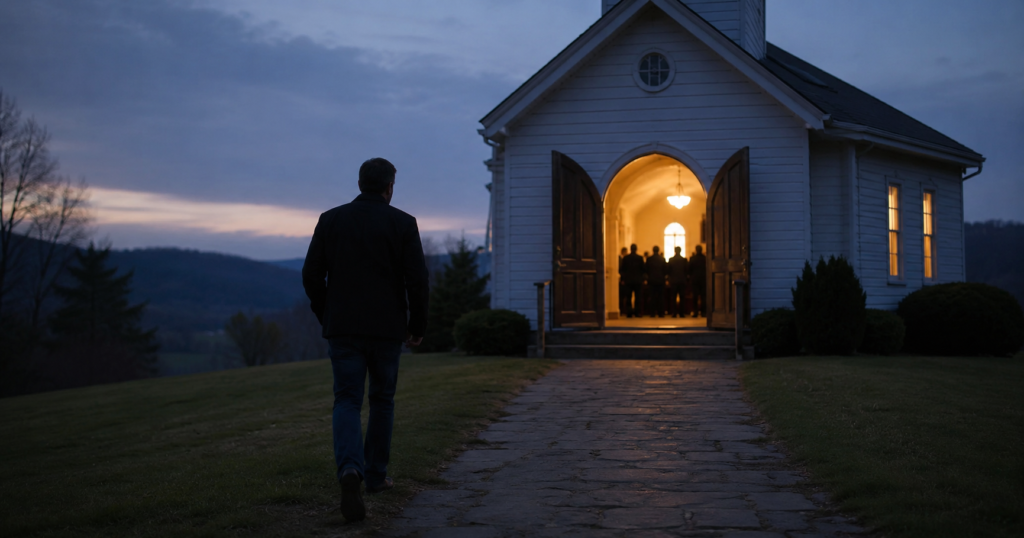

When was the last time you actually sat with God instead of just running errands for Him?
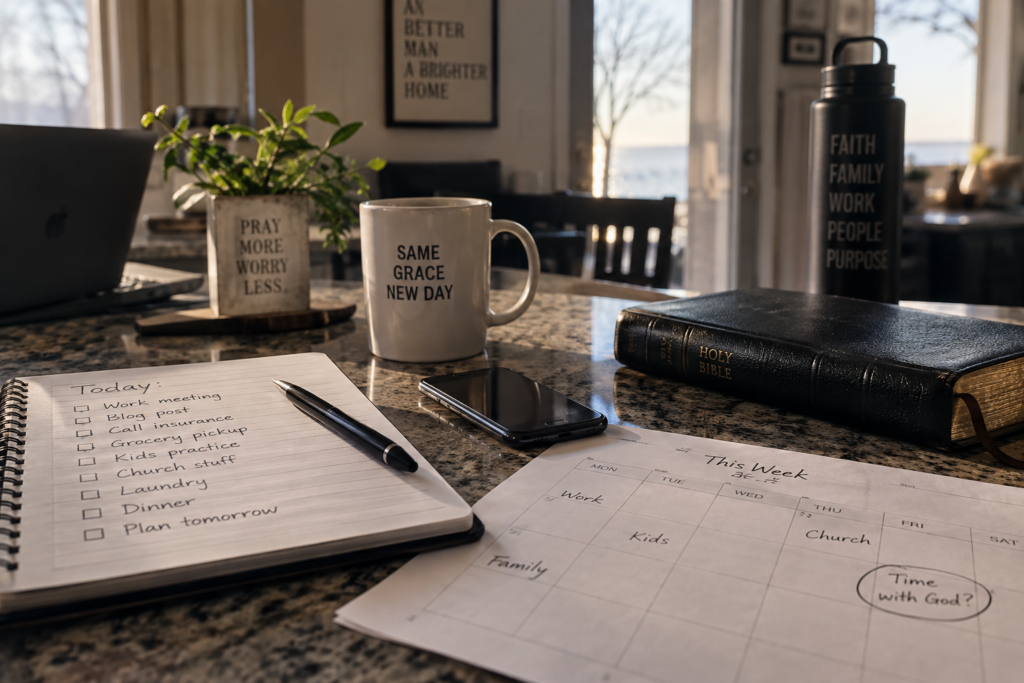
I asked myself that question not long ago, after a week where everything on my calendar got done. Work handled. A blog post published. Family taken care of. Church commitments kept. By every normal measure, it was a good week.
Then I sat still for about ten minutes and had to answer the question honestly. Not recently.
Somehow, I hadn’t noticed, because I was too busy checking things off to recognize what wasn’t getting done at all.
That was the day I realized being busy wasn’t the same as being faithful.
If you’ve ever had a week that looked full and responsible but still felt empty where it counted, you may understand exactly what I mean.
Being Busy Can Feel Like Faithfulness
Being busy has a way of dressing itself up as importance. A full calendar looks like a full life, and nobody questions the person who’s working hard, helping family, handling responsibilities, going to church, fixing problems, and showing up wherever he’s needed.
There’s nothing wrong with hard work. In fact, Colossians 3:23 tells us to work willingly at whatever we do, as though we’re working for the Lord.
The problem begins when doing things for God quietly replaces being with God.
Those are not the same thing.
When Paul describes the fruit the Holy Spirit produces in us in Galatians 5:22–23, one of the qualities he names is faithfulness. He doesn’t mention productivity, packed schedules, or how many boxes we checked before bedtime.
You can accomplish a remarkable amount and still neglect the things that matter most. You can serve everyone around you while your own walk with God begins drifting without you noticing.
That’s uncomfortable for me because I like getting things done. Checking something off a list gives me something visible to point to. Sitting quietly with God doesn’t always work that way.
Maybe that’s part of my problem.
I’ve gotten very good at measuring what I accomplish. I’m not always as good at measuring what all that accomplishing is doing to my soul.
Good Things Can Still Get in the Wrong Order
Most of what fills our weeks isn’t sinful. That’s what makes this harder.
Work supports our families. Family responsibilities matter. Church, helping people, maintaining a home, answering messages, and preparing for tomorrow can all be good things.
However, good things can still end up in the wrong order.
Jesus’ conversation with Martha in Luke 10:41–42 becomes uncomfortable when I stop treating it like a story about somebody else’s schedule. Martha wasn’t doing anything evil. She was serving, trying to take care of everyone.
But Jesus told her that worry over many things had crowded out what mattered most.
That sounds a little too familiar.
Sometimes the greatest threat to our time with God isn’t rebellion. It’s responsibility.
We add one good thing to the calendar, then another. Eventually, prayer becomes something we squeeze in. Scripture becomes something we’ll get back to when life settles down. Quiet time with God can even start feeling irresponsible because there’s always something else we could be doing.
The problem is that life rarely settles down on its own.
If we aren’t careful, we start fitting God into whatever space remains instead of building our lives around Him.
What Gets Your Best, and What Gets Your Leftovers?
Here’s a question I’ve had to sit with honestly: What gets my best hours, and what gets whatever is left of me?
Work often gets my sharpest thinking. Problems get immediate attention. My phone can steal more time than it deserves. Everyone else’s needs somehow find their way onto the schedule.
Then God can end up with the leftovers.
Maybe it’s five tired minutes before bed. Perhaps it’s a prayer while driving because I didn’t make time earlier. Sometimes it’s reading Scripture while half my mind is already working on the next problem.
That may not feel like neglect from the inside. In fact, it can look responsible because we’re still functioning.
Still, there’s a difference between making God part of our lives and putting Him first in our lives.
Being busy can hide that difference for a long time.
Eventually, I have to ask whether my schedule reflects what I say I believe. If God is truly first, there should be some evidence of that beyond what I say on Sunday.
Jesus Wasn’t Controlled by Urgency
Look closely at the Gospels and you’ll notice something important about Jesus: He had every reason to be busy.
Crowds pressed in around Him. Sick people needed healing. Grieving families needed comfort. His disciples needed teaching, while religious leaders constantly challenged Him.
Jesus also knew His earthly ministry was moving toward the cross.
If anyone had a reason to run Himself ragged meeting every demand, it was Him.
But He didn’t.
Luke 5:16 says Jesus often withdrew to the wilderness for prayer.
Often.
He didn’t wait until everybody stopped needing Him. Jesus withdrew while needs still existed.
That matters because Jesus understood something I keep having to relearn: urgency does not automatically equal assignment.
Consider what happened when Lazarus became sick. After hearing the news, John 11:6 tells us Jesus stayed where He was for two more days.
That makes little sense if faithfulness means immediately responding to whatever feels most urgent.
Pressure didn’t control Jesus. The Father did.
There’s a difference, and I’m beginning to think much of the stress in my life lives somewhere inside that difference.
Faithfulness Sometimes Requires No
I’m starting to realize saying yes to everything doesn’t prove faithfulness. Sometimes saying no does — when it protects what God has actually given me.
Every yes costs something because time doesn’t magically expand when another responsibility lands on the calendar. Nobody’s figured out how to make a day longer than twenty-four hours, no matter how full the calendar gets.
When I add something, the time has to come from somewhere.
That reality changes the questions I need to ask. Instead of automatically thinking, Can I do this? I need to ask, Is this mine to carry?
Those are very different questions.
I’m capable of carrying a lot. For most of my life, I’ve considered that a strength, and sometimes it is. Other times, that strength becomes the reason I end up quietly believing everything depends on me.
Being capable of carrying something doesn’t mean God asked me to pick it up.
Sometimes no isn’t selfish. Sometimes no is stewardship.
A well-placed no can protect a much more important yes.
Am I Busy, or Am I Doing What God Gave Me to Do?
I’ve asked myself, How do I slow down? That’s a useful question, but I don’t think it’s the deepest one.
The harder question is this: Am I doing what God has actually called me to do, or am I simply doing everything that asks something from me?
You can slow down and still spend your time on the wrong things. Therefore, this isn’t only about moving slower. It’s about living deliberately.
I need to examine whether the things consuming my energy line up with what I claim matters most: God, my wife, my family, the people I love, my health, the work God has given me, this ministry, prayer, rest, and actually being present.
Those things shouldn’t constantly receive whatever remains after the rest of the world finishes taking its share.
There will always be another task, problem, notification, email, phone call, or person who would happily spend an hour of my life for me.
The calendar will never announce, Congratulations. You’ve finally handled everything. Now you may concentrate on what matters.
We have to choose.
What I’m Changing About Being Busy
I’m not interested in writing another article where I identify something that needs to change, make a few observations about it, and then continue living exactly the same way.
So here’s what I’m actually working on.
Before accepting another responsibility, I want to filter it first: is this actually mine to carry? Being able to do something doesn’t automatically mean I’m supposed to do it.
I’m also trying to give God more than the leftovers. If I believe He comes first, my schedule eventually needs to support that claim — prayer and Scripture can’t keep depending on whatever energy happens to be left at the end of the day.
Separating responsibility from control matters too. I have responsibilities God expects me to handle, but I’m not responsible for controlling every outcome. Those are two very different burdens.
And each week, I want to review it honestly: did the way I lived match what I say matters most? I’m not chasing a perfectly optimized Christian schedule. I simply want the direction of my life to match the priorities of my faith.
None of this requires abandoning responsibility. It requires putting responsibility back in its proper place.
That’s something I need to practice, not merely understand.
I Don’t Want God Getting What’s Left of Me
I don’t think the answer is quitting your job, canceling every commitment, throwing your phone into Lake Erie, and spending eight hours a day reading Leviticus.
Although the phone part occasionally has appeal.
The answer is learning the difference between responsibility and control, calling and obligation, availability and obedience.
I’ve had to confront that recently while asking when everything started depending on me. Brian wrote about another side of the same struggle in My Will Be a Dead Man, where he examines the daily battle between our will and God’s will.
Maybe being busy is part of that battle too.
My will likes productivity because productivity makes me feel useful. Control makes me feel safe, and checking boxes gives me proof I didn’t waste the day.
Faithfulness requires something deeper.
It requires trust, obedience, presence, and the wisdom to know when to move and when to sit still. It means doing the work God gives me without acting as though I’m personally responsible for keeping the entire world from falling apart.
I don’t want to reach the end of another week having completed every task while neglecting the One I’m supposedly doing all of this for.
More than that, I don’t want to become so good at being busy that I stop noticing when I’m no longer being faithful.
So here’s the question I’m asking myself:
Did God get my best this week, or did He get what was left of me?
Then comes the harder question:
Was I faithful, or was I just busy?
Those questions can rearrange more than your calendar.
They can rearrange your life.