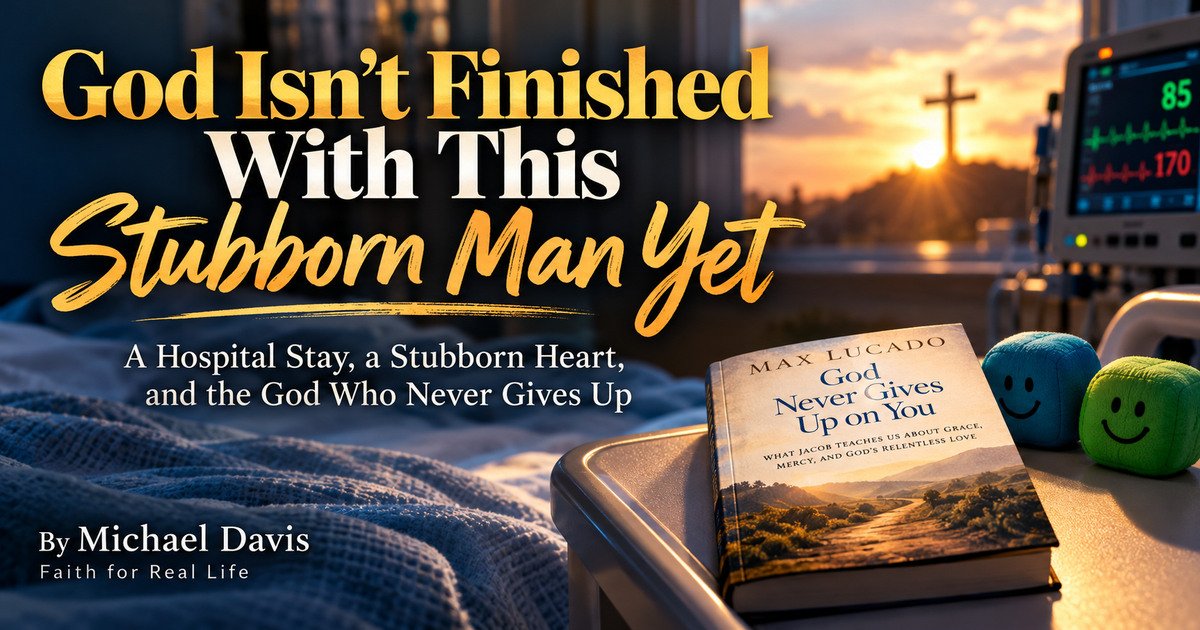
Of all the unread books at home, I picked one before I even knew whether I’d be admitted to the hospital. I set it aside and asked Annita to bring it if I had to stay.
As it turned out, I had to stay.
The book was God Never Gives Up on You by Max Lucado. It tells the story of Jacob, a schemer who made a mess of his family relationships, and the God who never walked away from him.
So far, I’m only five chapters in. Two of those chapters stopped me in my tracks. Lying in a hospital bed after another episode with my heart, I can’t shake the feeling that God may be showing me something I’ve been too stubborn to see.
Another Night in the Emergency Room
A little after 10 p.m. on Thursday, October 15, after putting it off longer than I should have, I finally ended up in the emergency room at Firelands Regional Medical Center. My heart was pounding, and I was struggling to catch my breath. At one point, my heart rate reached around 170 beats per minute.
Here we go again.
Heart problems have followed me since I was 38. Doctors found a 99% blockage in one of my coronary arteries and placed a stent. Then came years of atrial fibrillation (AFib), two ablations, and a Watchman device implanted this past May.
Despite all of it, there I was again, lying in another hospital bed and wondering what would happen next.
The ER was packed. There were tests, blood draws, X-rays, and a lot of waiting. Medication eventually brought my heart rate down to around 85, but the monitor still showed signs of AFib. Every so often, I still struggled to breathe.
At one point, I noticed what looked like a crash cart sitting in my room. Nobody explained why it was there, and I’d be lying if I said it didn’t rattle me.
I had also brought two stress cubes along. That makes me smile now. Even in the ER, apparently Papa needed his squishies!
I wish I could tell you I handled the night with patience and a cheerful attitude, but that wouldn’t be true. Frustration set in, and I was exhausted.
I’m tired of heart problems, tired of procedures, and tired of wishing for a quick fix that doesn’t seem to exist. Yes, I have plenty to be thankful for. In that moment, though, I was having a hard time focusing on any of it.
By Friday afternoon, I finally had a regular room. That evening, my medications were adjusted, and my heart went back into normal rhythm. If everything stays stable, I may be discharged Saturday. My cardiologist and I will meet again in about four weeks to talk about what comes next.
I don’t have every answer, but I’m thankful for the improvement. Once I was settled, I opened the book Annita brought me.
That’s when this hospital stay began to feel like more than waiting for medical answers.
Chapter One: The Tilted Halo Society
Lucado’s first chapter sounded a lot like the reason I started Faith for Real Life. I never intended to write from a place of perfection.
This website doesn’t exist because I’m a perfect Christian. I’m a sinner trying to follow Jesus, and I still get plenty of things wrong.
Some days, I lose my patience. Other times, I worry, become prideful, or try to control something I should have handed over to God long ago.
More than once, I’ve written about trusting God and then struggled to trust Him myself. I’ve encouraged forgiveness while still working through my own hurt. I’ve talked about patience, only to lose mine over something I couldn’t control.
Those struggles came out in my article Why Is It So Hard to Be a Christian? They weren’t theoretical then, and they certainly aren’t tonight.
That’s the tilted halo.
Faith for Real Life was never about showing people how strong or perfect my faith is. It’s about pointing them toward a faithful God who hasn’t given up on me, even when I fall short.
Jacob’s story reminds me that God works through imperfect people. He knows our faults, our weaknesses, and even the things we’d rather keep hidden.
Yet His grace isn’t permission to stay stubborn or keep making the same mistakes without learning from them.
Chapter Five made sure I didn’t overlook that part.
Chapter Five: The Trickster Gets Tricked
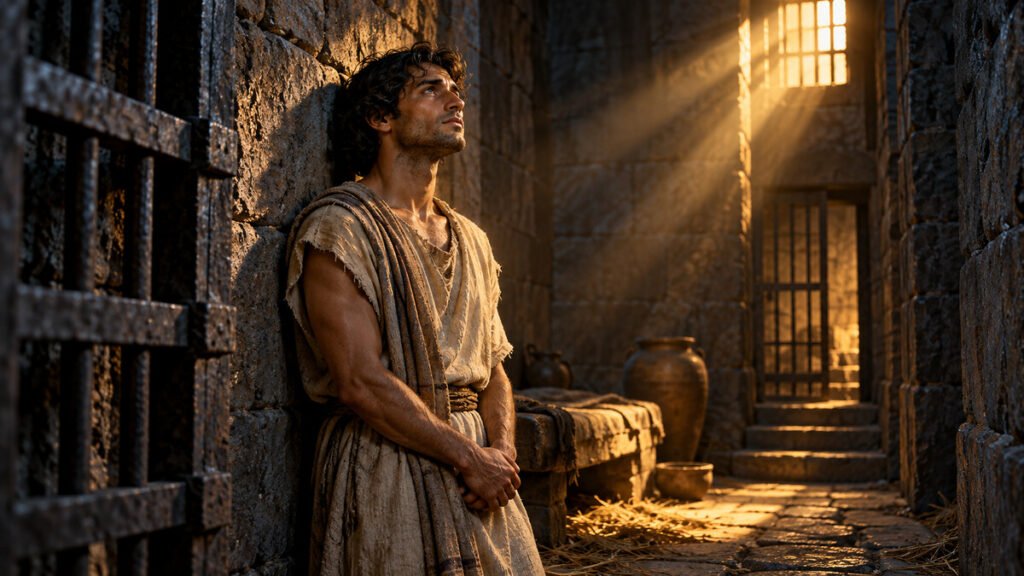
Jacob knew what he was doing when he deceived his father, Isaac, and received the blessing intended for his older brother, Esau. The fallout created a family crisis and sent him running from home. You can read about it in Genesis 27 (NLT).
Eventually, Jacob ended up in his uncle Laban’s household and fell in love with Rachel. He agreed to work seven years for the chance to marry her.
According to Genesis 29:20 (NLT), those seven years seemed like only a few days because he loved her so much.
Finally, the wedding day arrived. There was a feast, and Jacob believed he was getting what he’d worked so hard for.
Then morning came.
It was Leah, not Rachel.
Laban had deceived him.
When Jacob confronted his uncle, Laban defended himself by appealing to local custom. The younger daughter, he explained, could not marry before the older one. You can read the account in Genesis 29:15–30 (NLT).
Max Lucado points out the irony in this story, and once I saw it, I couldn’t get it out of my mind.
Jacob had taken his older brother’s blessing through deception. Now Laban was using the older sister’s position to justify deceiving Jacob.
Same kind of trick.
Different people, different time, different tent.
The deceiver had been deceived. Now Jacob was on the receiving end of the same kind of dishonesty he’d once practiced himself.
Scripture doesn’t tell us whether Jacob recognized any of himself in Laban that morning. Maybe he was too focused on how unfairly he’d been treated to consider what he’d done to his own family.
I’d like to think I would have recognized the connection.
Truthfully, I’m not so sure.
How often do I recognize something wrong in another person while overlooking that same behavior in myself?
When Getting What We Want Blinds Us
Jacob had always been clever and calculating when he wanted something. Then he met Rachel, and she became the center of his world. After seven years of work, the moment he’d waited for had finally arrived.
Scripture doesn’t explain why he didn’t recognize Leah that night, and I won’t pretend to know. But his story raises a question I can’t ignore.
Can I become so focused on what I want that I stop noticing what God may be trying to teach me?
I don’t have to look far for the answer. This week, I wanted my normal life back so badly that I ignored what my own heart was telling me.
We all do some version of that. We defend old habits, resist change, and convince ourselves our way is good enough. Sometimes we get comfortable with attitudes that quietly hurt the people closest to us.
It’s easy to recognize those patterns in someone else. Admitting I do the same thing is much harder.
I’ve written before about When God Changes What You Want. Jacob’s story shows me the other side of that lesson.
Sometimes the problem isn’t simply what we want. It’s how stubbornly we hold onto it and what we overlook while chasing it.
Not Karma, and Not God Making Anyone Sin
On the surface, Jacob’s story almost sounds like what people call karma. He deceived someone, and eventually someone deceived him.
But I believe there’s more to it than that.
God already knew how Jacob’s life would unfold. That doesn’t mean He made Laban lie or approved of either man’s actions. Both men were responsible for their own choices.
Still, Jacob’s earlier decisions helped shape the road he traveled. His deception sent him away from his family and eventually brought him into Laban’s household.
Galatians 6:7 (NLT) reminds us that we harvest what we plant. Our choices matter, and sometimes their consequences open our eyes to things we haven’t been willing to see.
But hear me on this.
Not every hardship is punishment from God.
My heart trouble isn’t proof that God is correcting me for some specific sin. That’s not something I believe, and it isn’t something Scripture gives me the authority to claim.
If you’re sitting in a hospital room tonight, facing an illness, a frightening diagnosis, or circumstances you never asked for, I don’t want you believing your suffering automatically means you’ve done something wrong.
Even so, God can use difficult moments to get our attention, strengthen our faith, and help us see what needs to change.
Long before Jacob ever met Laban, God had already promised to be with him and not abandon him in Genesis 28:15 (NLT).
God knew Jacob’s weaknesses, yet He kept working in his life.
Grace didn’t mean Jacob had nothing left to learn. It meant God wasn’t finished with him.
That truth brings comfort, but it also brings responsibility.
Maybe It’s Time to Look in My Own Mirror
Here’s the part of this story that makes me uncomfortable.
I can be a very stubborn man.
That’s a lot easier to type than it is to admit when I’m the one who needs to change.
My stubbornness showed up before I ever reached the emergency room. My heart was acting up, and instead of going in, I put it off. I tried to power through, hoping it would settle down on its own.
Why would I do that? Because I’m tired. I’ve dealt with heart problems since I was 38, and lately, AFib has kept getting in the way of my life, my family, and my plans. Another trip to the ER felt like one more thing my heart was taking from me.
So I waited.
For years, my approach has been simple: learn, adapt, and adjust. That mindset has carried me through a lot. But powering through a heart problem isn’t adapting. It could have done real damage, or worse.
That wasn’t strength. It was stubbornness.
If you’re putting off a doctor because you’re tired of being a patient, please don’t wait like I did, especially when your symptoms involve your heart or your breathing.
Even once I got there, I wanted a timeline, a plan, and an answer. Preferably all on my schedule.
Patience isn’t my strong suit. Neither is admitting that I’m not in control. I’ve written about that struggle in When Did Everything Start Depending on You?, and yet here I was facing it again.
I talk about trusting God, then get frustrated when I can’t see the solution. There’s already an article on this website called Knowing Better Isn’t the Same as Living Better. This hospital stay reminded me that I’m still living that title.
James 1:22–25 (NLT) describes someone who looks in a mirror, walks away, and forgets what he saw. That’s what happens when we hear God’s Word but fail to put it into practice.
I don’t want to read about Jacob’s stubbornness and then walk away without confronting my own. Nor do I want to write another article about obedience while ignoring what I already know God wants from me.
Maybe I need to listen more and complain less.
Perhaps I need to notice when my pride gets in the way, or when my stubbornness affects the people around me.
Most of all, I need to remember that trusting God isn’t something I practice only when life goes the way I want it to.
Seeing the lesson isn’t the same as living it. If recognizing these things doesn’t change how I respond, then I’ve missed the point.
Of All the Books I Could Have Chosen
My shelves at home are full of books I haven’t read yet. Out of all of them, this was the one I chose to bring to the hospital.
Now I’m reading about a deeply flawed man whom God refused to give up on, right in the middle of another difficult chapter of my own life.
I’m not going to tell you God put me in this hospital bed to teach me about Jacob. That’s not what I believe.
But I do believe He can meet me here.
Maybe the question I need to ask isn’t only, “Why am I going through this again?”
Perhaps I also need to ask, “Lord, what do You want me to learn while I’m here?”
Tonight, my heart is back in normal rhythm, and that’s a blessing. I’m thankful for Annita, my family, everyone who has prayed for me, and the doctors and nurses taking care of me.
I’m also thankful for an uncomfortable reminder.
There’s still more of Jacob’s story left to read, and there’s certainly more growing left for me to do. I don’t know what the next few chapters of this book will teach me, what the next few months will bring for my heart, or even whether I’ll be heading home tomorrow.
What I do know is this: God isn’t finished with this stubborn man yet. And I don’t want to be so set in my ways that I miss what He’s trying to show me, in this hospital bed and long after I walk out of this room.
My Prayer Tonight
Heavenly Father,
Thank You for not giving up on me. You brought me through another frightening and exhausting experience with my heart, and I’m grateful. Thank You for Annita, for every prayer, and for everyone who has been caring for me.
Lord, You know where I’m stubborn. You see the habits I defend, the frustrations I hold onto, and the times I try to control things that belong in Your hands.
Forgive me for the times I put off what I know I need to do. Help me stop waiting until I have no other choice.
Give me the humility to admit when I’m wrong and the strength to make the changes I need to make. Teach me to be more patient, more understanding, and more willing to listen. Help me look honestly at myself before I judge the actions of someone else.
Most of all, Lord, don’t let me become someone who reads Your Word, writes about it, and then forgets to live it.
Keep working on me, even when I’m slow to learn.
In Jesus’ name, amen.
Something to Think About
Have you ever recognized your own habits or mistakes in someone else’s story? Sometimes God uses other people’s experiences to show us what we’ve been overlooking in ourselves.
I’d love to hear your thoughts in the comments. And if you know someone who needs the reminder that God hasn’t given up on them, please share this article.
Continued in: Jacob Walked Away Limping. Most of Us Do., what finishing Lucado’s book showed me about regret, fatherhood, and grace.