
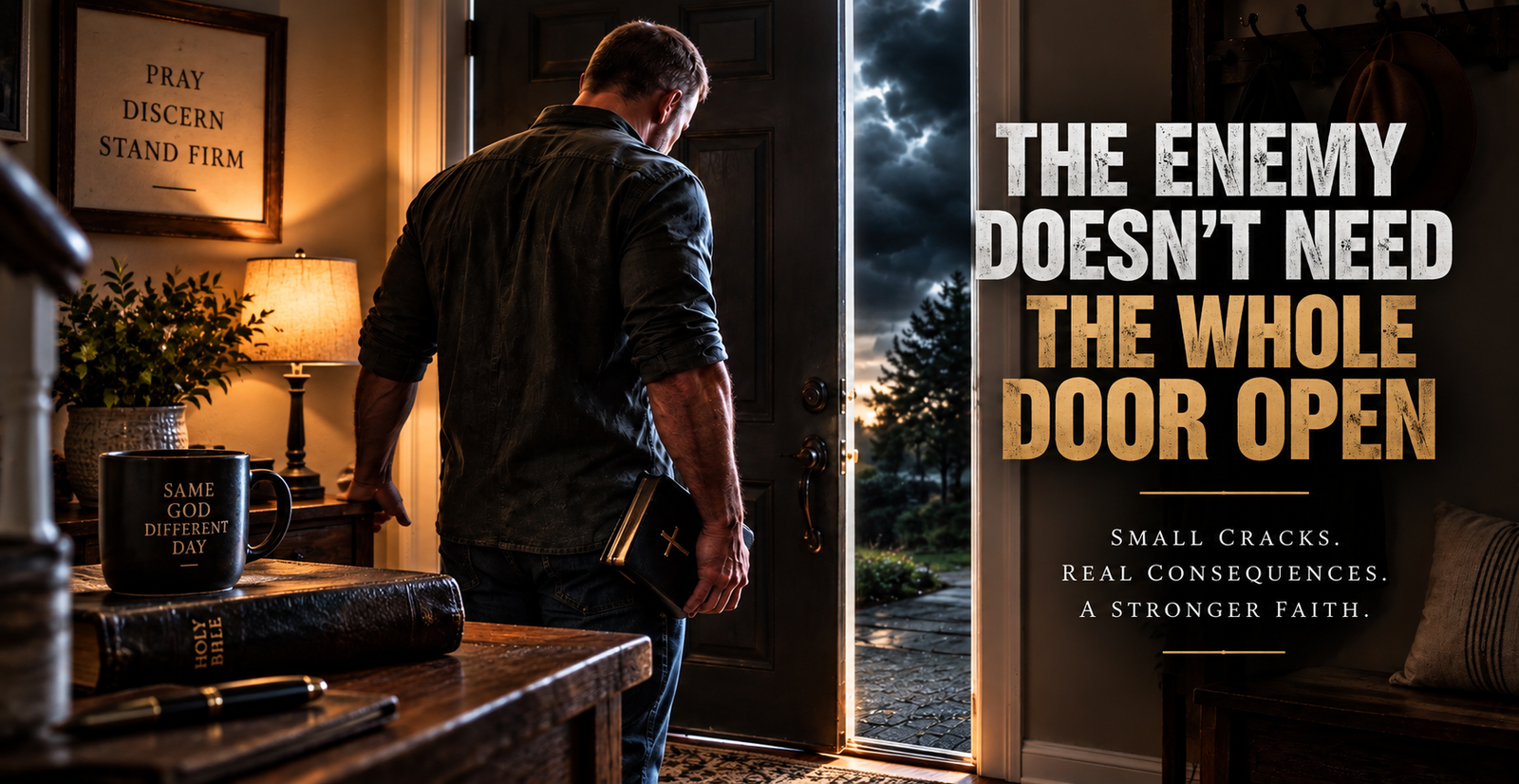
We tend to picture spiritual warfare as something dramatic. Something loud. Something you’d recognize the second it showed up.
I’m starting to think some of the most dangerous battles start a lot quieter than that.
I’ve had weeks where nothing dramatic happened, and I still ended up short-tempered, distracted during prayer, irritated by things that normally wouldn’t touch me. Nothing “bad” occurred. I just hadn’t dealt with the small stuff for long enough that it started dealing with me.
A stressful week. A little anger you never actually deal with. Somebody’s words that still sting three days later. Exhaustion that doesn’t lift, no matter how much sleep you get. A prayer life that keeps getting pushed to whenever there’s time — which lately is never.
One of those doesn’t seem dangerous. Neither does the next one. But put fifty of them together, and you’re carrying something you were never built to carry. And somewhere under that weight, a crack forms.
I wrote recently about those fifty little weights — the small pressures that pile up until we hardly recognize how much we’re carrying. Spiritual warfare can meet us right there, not because stress itself is evil, but because prolonged pressure can expose places in us that need attention.
Watch the Root, Not Just the Moment
Scripture doesn’t say much about how big the opening has to be.
“Watch out that no poisonous root of bitterness grows up to trouble you, corrupting many” (Hebrews 12:15, NLT). Not a flood. A root. Something small enough to go unnoticed for a long time, growing exactly because nobody’s watching for it.
That’s the piece I think gets missed. We wait for spiritual warfare to look like a crisis. Most of the time it doesn’t announce itself. It just finds the crack that’s already there and gets comfortable.
Paul says almost the same thing about anger: “Don’t sin by letting anger control you… for anger gives a foothold to the devil” (Ephesians 4:26-27, NLT). Foothold. Not possession. Not some Hollywood scene. Just enough room to stand.
I want to be careful here, because I don’t think every bad mood is Satan. Sometimes you’re just tired. Life can also be genuinely hard, and it has nothing to do with anything spiritual — it’s just Tuesday. Sometimes you’re dealing with the consequences of your own choices, and no amount of spiritual language changes that.
But Scripture is clear that there is a real enemy, and it repeatedly warns us not to give him room. The danger isn’t simply having a hard day. It’s allowing anger, bitterness, fear, or temptation to settle in without dealing with it.
How the Drift Happens
Here’s roughly how it goes, if you let it: stress turns into exhaustion. Exhaustion turns into irritability. Irritability turns into anger you don’t deal with. That anger turns into bitterness. Bitterness turns into pulling away from the people who’d actually help you carry it. And somewhere in there, without ever making a decision to, you’ve drifted.
Most people examine the blow-up — the argument, the harsh word, the day it finally spilled over. Almost nobody examines the root that had been sitting there for weeks before that happened. We examine the explosion. We almost never examine the root that caused it.
The enemy doesn’t need a new strategy every time. The patterns we leave unguarded can become familiar openings: the same short temper, the same pride, the same resentment, the same fear. That’s why self-examination matters. If you know where you tend to fall, guard that place before the pressure comes.
You don’t drift into bitterness overnight. You drift into it one unguarded day at a time.
It Was Never Really Just About You
There’s something in the book of Job worth sitting with here.
Before Job loses anything, Satan appears before God and questions Job’s faithfulness. His accusation is essentially this: Job only trusts God because life has been good to him. Take away the blessing, and his faith will disappear (Job 1:6-12, NLT).
That matters because Job reminds us that spiritual warfare isn’t always about some obvious temptation or spectacular moment. Sometimes the question underneath the pressure is much simpler: Will I still trust God when life hurts?
Job didn’t understand everything happening around him. He didn’t know about the conversation recorded in heaven. He just knew his life had suddenly become painfully heavy. And Scripture never tells us that Job caused it by leaving some spiritual door unlocked.
But that distinction matters too. Not every hardship is the result of a foothold we gave the enemy. Sometimes suffering comes simply because we live in a broken world. Sometimes God allows things we don’t understand. Spiritual vigilance should make us more faithful, not make us blame ourselves or somebody else every time life becomes difficult.
Pressure Reveals What You’re Standing On
But Job does show us something important: pressure reveals what we are standing on. And Christians don’t stand on our ability to outsmart the enemy. We stand on Christ.
Revelation calls Satan “the accuser” and points toward his ultimate defeat through the victory of Christ (Revelation 12:10-11, NLT). The New Testament holds both truths together: the enemy is real and active, but his defeat is certain.
That means we don’t have to panic when the battle gets difficult. We resist. We pray. Then we hold onto truth. We keep trusting God when circumstances are trying to convince us He has disappeared.
The enemy may fight. He does not get the final word. Jesus does.
That’s not a reason to be afraid. It’s a reason to stay standing.
Put On What That Actually Means Monday Morning
Ephesians 6 tells us to put on the full armor of God, and I think most of us read past it like it’s decoration (Ephesians 6:10-18, NLT). It isn’t. It’s meant to be worn head to toe, every piece doing something specific, not admired — used.
The belt of truth goes on first, holding everything else together, because it means not believing the first thing your exhaustion tells you about your situation, your family, or yourself. The breastplate of righteousness guards the heart. It means choosing what honors God before anger, pride, or emotion gets to make the decision for you.
Feet fitted with the readiness of the gospel of peace mean you can walk into a hard conversation without carrying the fight into it yourself. The shield of faith is what actually puts out the thought before it becomes a spoken word you can’t take back. The helmet of salvation guards your mind — one of the first places fear, accusation, temptation, and distorted thinking try to take hold. And the sword of the Spirit isn’t decoration either; it’s the one thing that answers a lie with something true instead of just something louder.
Wear the Armor Before the Battle
None of that is mystical. It’s what standing firm looks like on an ordinary Tuesday, before anything’s gone wrong yet. And it’s not armor you rent for the bad days. It’s meant to be worn — the whole suit, every day, covered in the love and protection of Jesus Christ Himself.
The armor isn’t for the day the attack is obvious. It’s for every day before that one.
James puts the whole strategy in two moves: “Humble yourselves before God. Resist the devil, and he will flee from you. Come close to God, and God will come close to you” (James 4:7-8, NLT). Resist and draw near. That’s it. Not a formula. A direction to keep facing.
Live Awake, Not Afraid
There is authority in resisting. You don’t have to cooperate with every angry thought, fearful lie, temptation, or bitterness that tries to settle into your life. Bring it into the light. Pray against it. Answer lies with Scripture. Refuse to give it room in your mind, your marriage, or your home.
“The Spirit who lives in you is greater than the spirit who lives in the world” (1 John 4:4, NLT).
That isn’t permission to become arrogant about spiritual warfare. It’s a reason not to be afraid of it. Our confidence isn’t in how tough we are. It’s in who Christ is.
Ultimately, the goal isn’t to walk around afraid that Satan is behind every hard day. The goal is to stop being careless about the places where bitterness, anger, and exhaustion are already taking root.
And this part matters, because none of this stays private. When one person in a house loses their peace, the whole house starts to feel it eventually. That’s not guilt — it’s just true. Which means guarding your own heart was never really just about you.
Stop worrying about what anyone else thinks of you for taking this seriously. You don’t answer to them. You answer to God, and He already knows exactly what you’re carrying. The only reflection that matters is the one that looks like Christ.
You don’t have to live paranoid. You do have to live awake.











One Response
Amen