
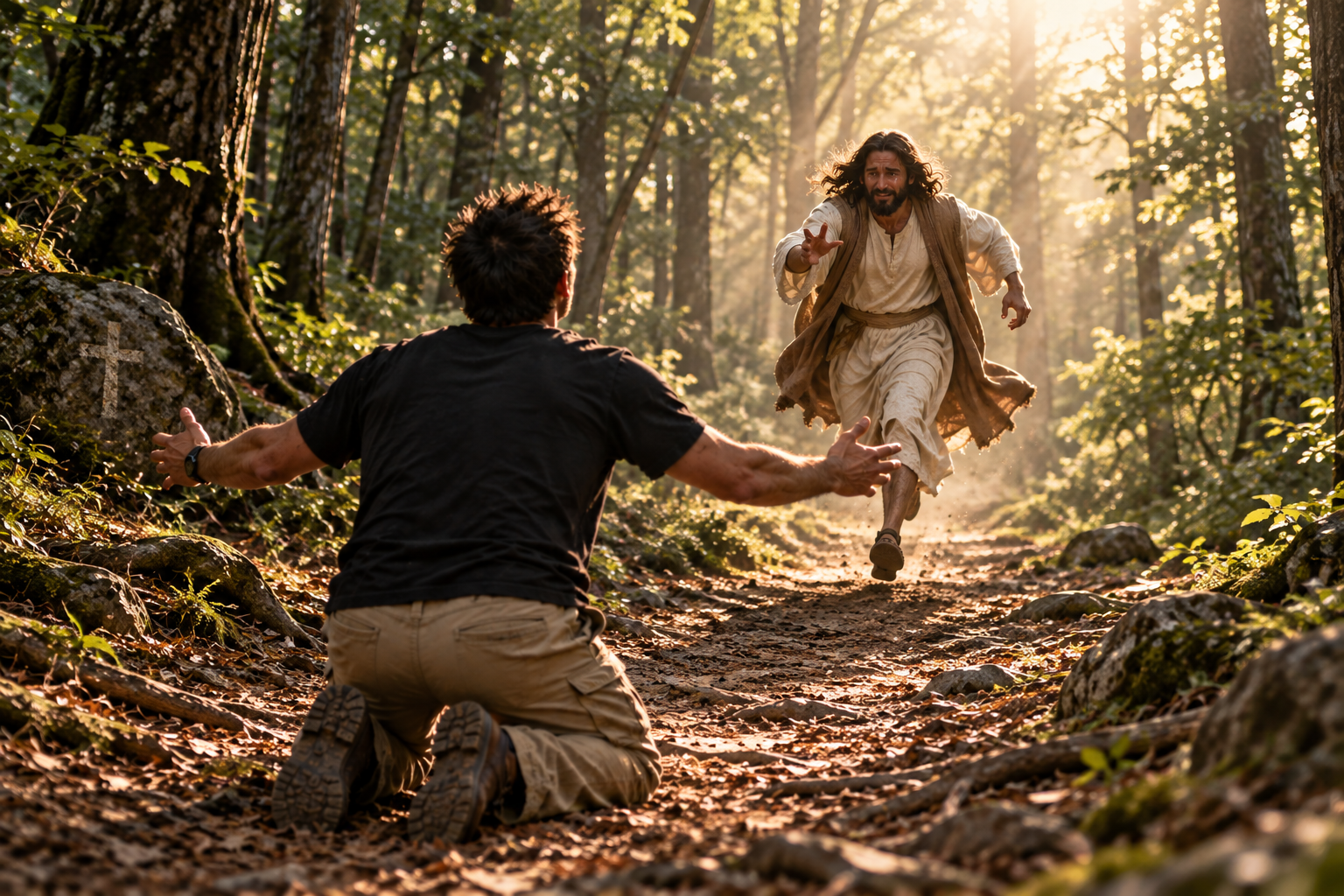
There is a song I’ve listened to for years called When God Ran. It was originally recorded by Benny Hester, although the version I’ve always preferred is the more modern version by Shaded Red. I’ve heard the song plenty of times, but the older I get, and especially after everything I’ve walked through recently, the more powerful its message becomes.
The song is based on one of the most familiar stories Jesus ever told: the Prodigal Son in Luke 15. But sometimes familiarity causes us to miss just how shocking the story really is. Recently, I read Chip Ingram’s God: As He Longs for You to See Him, a book about seeing God as He actually reveals Himself in Scripture rather than seeing Him through the distorted lenses of our experiences, disappointments, fears, or misconceptions. Ingram examines God’s goodness, sovereignty, holiness, wisdom, justice, love, and faithfulness. As I thought about those attributes, I kept coming back to When God Ran, because if you want to know what God is like, one of the most beautiful places to look is at the father in Jesus’ story.
A man had two sons. The younger son approached his father and asked for his inheritance. We can read past that pretty quickly, but it was an astonishing rejection. Essentially, the son wanted what belonged to his father without wanting a relationship with his father. He wanted what his father could give him, and then he wanted to leave. The son traveled to a distant country and wasted everything in reckless living. Eventually, the money disappeared. The good times disappeared. A famine came, and the young man who had once possessed a substantial inheritance found himself feeding pigs and longing to eat their food.
Then comes one of my favorite phrases in the story. Luke 15:17 says, “And when he came to himself…” He finally saw where his choices had taken him. There is something incredibly powerful about that moment because repentance often begins there. We stop running. We stop making excuses. We look honestly at where we are and realize, I can’t keep going in this direction.
The son remembered his father. He realized that even his father’s servants had food while he was starving, so he started rehearsing a speech. He would return home, confess his sin, and tell his father he was no longer worthy to be called his son. He wasn’t expecting restoration. He wasn’t expecting a celebration. He was simply hoping his father might allow him to become a servant.
Then Jesus gives us one of the most beautiful pictures of God anywhere in Scripture. Luke 15:20 says, “But when he was yet a great way off, his father saw him, and had compassion, and ran.”
Think about those words for a moment. He was still “a great way off.” The son hadn’t made it home yet. He hadn’t finished his speech. He hadn’t worked off his debt. He hadn’t proven himself. He hadn’t demonstrated years of changed behavior. He was simply coming home, and his father saw him.
I sometimes wonder how the father saw him while he was still a great way off. Jesus doesn’t tell us that the father had been standing there watching the road every day, so we shouldn’t add something to Scripture that isn’t there. But the picture certainly makes me wonder whether he had been hoping for this day. However it happened, the father recognized his son in the distance, had compassion on him, and then did something extraordinary.
He ran.
That’s the image behind When God Ran that I find so powerful. The father didn’t stand on the porch with his arms crossed. He didn’t wait for his son to crawl all the way home. He didn’t demand repayment before offering forgiveness. He didn’t tell him that he had made his bed and now had to lie in it. Instead, the father ran toward the son who had rejected him, squandered what he had been given, and returned home with nothing to offer except repentance.
Luke tells us that the father embraced his son and kissed him. The son began his prepared confession: “Father, I have sinned against heaven, and in thy sight, and am no more worthy to be called thy son.” But something interesting happens. Earlier, when the son rehearsed his speech, he planned to add, “Make me as one of thy hired servants.” When he actually meets his father, he never gets to that part.
Instead, the father calls for the best robe. He puts a ring on his hand and shoes on his feet. He orders the fattened calf to be prepared and explains why: “For this my son was dead, and is alive again; he was lost, and is found” (Luke 15:24).
That’s grace, and I need that picture of God.
Sometimes I think we imagine God standing at the end of the driveway with His arms crossed, waiting for us to explain ourselves. We think He’s looking at everything we’ve done wrong, shaking His head and wondering whether we’re worth another chance. But that’s not the Father Jesus described. The Father Jesus described ran.
That doesn’t mean the Father doesn’t care about sin. In fact, the story doesn’t make sense without repentance. The son had to “come to himself.” He had to recognize his sin. He had to turn around. He had to leave the far country and start walking toward home. Grace doesn’t mean sin doesn’t matter. Grace means sin doesn’t get the final word when a sinner turns toward the Father.
I need to remember that because I haven’t always gotten everything right either. It’s easy when you’ve been hurt to focus almost exclusively on what everyone else has done. I know the things that have hurt me. I know the things I believe were unfair. I know the decisions other people have made that I wish they could undo. But I also know me. I’ve sinned. I’ve made mistakes. I’ve allowed anger to get the better of me. I’ve said things I shouldn’t have said. I’ve questioned God. I’ve tried to control situations I couldn’t control. I’ve needed forgiveness more times than I could possibly count.
There is a little bit of the prodigal in me too. Actually, there is a prodigal in all of us. Romans 3:23 says, “For all have sinned, and come short of the glory of God.” None of us comes to the Father because we’ve earned our way back home. We come because we desperately need His grace.
Maybe you’ve spent years running from God. Maybe you’ve made decisions you’re ashamed of. Maybe you’ve wrecked relationships. Maybe addiction has taken you farther than you ever thought you’d go. Maybe anger has controlled you. Maybe you’ve been hiding something. Maybe you’ve convinced yourself you’ve gone too far for God to want you anymore.
If that’s you, look again at the road in Luke 15. The son is walking home. He’s dirty. He’s broken. He has nothing left. He’s rehearsing his confession. He sees the house in the distance and probably wonders what his father is going to say when he gets there. Then suddenly, someone is coming down the road toward him.
It’s his father, and he’s running.
That’s the God Jesus wanted sinners to see. Romans 5:8 says, “But God commendeth his love toward us, in that, while we were yet sinners, Christ died for us.” Those words are incredibly important: while we were yet sinners. Not after we cleaned ourselves up. Not after we repaired everything we’d broken. Not after we had enough good days to outweigh the bad ones. Christ died for us while we were sinners. The cross is the ultimate demonstration of the God who moves toward prodigals.
That’s what I love about When God Ran. The song takes the majesty, holiness, and power of God and places them alongside this almost unimaginable picture of His love. This is the almighty God, the holy God, the righteous God, the Creator, the Judge, and the King, and yet Jesus gives us the picture of a Father who ran toward His lost son.
Maybe you’re reading this from the far country. Maybe you’ve wandered farther than you ever intended. Maybe you’ve spent everything you thought would make you happy and discovered that you’re still empty. Maybe you’re sitting spiritually among the pigs wondering how you ended up there.
Luke 15 gives you a simple direction: come home.
You don’t have to pretend you didn’t sin. You don’t have to justify what you’ve done. You don’t have to blame someone else. The prodigal didn’t come home with excuses. He came home repentant. 1 John 1:9 promises, “If we confess our sins, he is faithful and just to forgive us our sins, and to cleanse us from all unrighteousness.”
So turn around and start walking toward the Father. You may feel filthy. You may feel ashamed. You may think you’ve gone too far. You may wonder what God could possibly want with you after everything you’ve done. But remember what Jesus told us happened when the prodigal was still “a great way off.”
His father saw him, had compassion on him, and ran to meet him. That’s the God who runs toward prodigals, and that includes people like me.
–
Listen to the song, When God Ran
Almighty God, the great I Am
Immovable rock, omnipotent, powerful, awesome Lord
Victorious warrior, commanding King of kings, mighty conqueror
And the only time, the only time I ever saw Him run
Is when He ran to me, took me in his arms
Held my head to his chest, said my son’s come home again
Looked at my face, wiped the tears from my eyes
With forgiveness in his voice he said son, do you know I still love you?
It caught me by surprise, brought me to my knees
When God ran
The day I left home, I knew I had broken his heart
I wondered then if things could ever be the same
Then one night, I remembered his love for me
And down that dusty road ahead I could see
I saw Him run to me
It caught me by surprise
Brought me to my knees
When God ran







One Response
A beautiful picture of the grace plus mercy we as parents need to emulate, a perfect Heavenly Father! King of Kings and Lord of Lords! We all will answer to Him! May we choose carefully the steps our Father requires of us!
Love this amazing picture of the prodigal son or daughter in the Bible! Fits perfectly for us all!♥️🙏🙏