
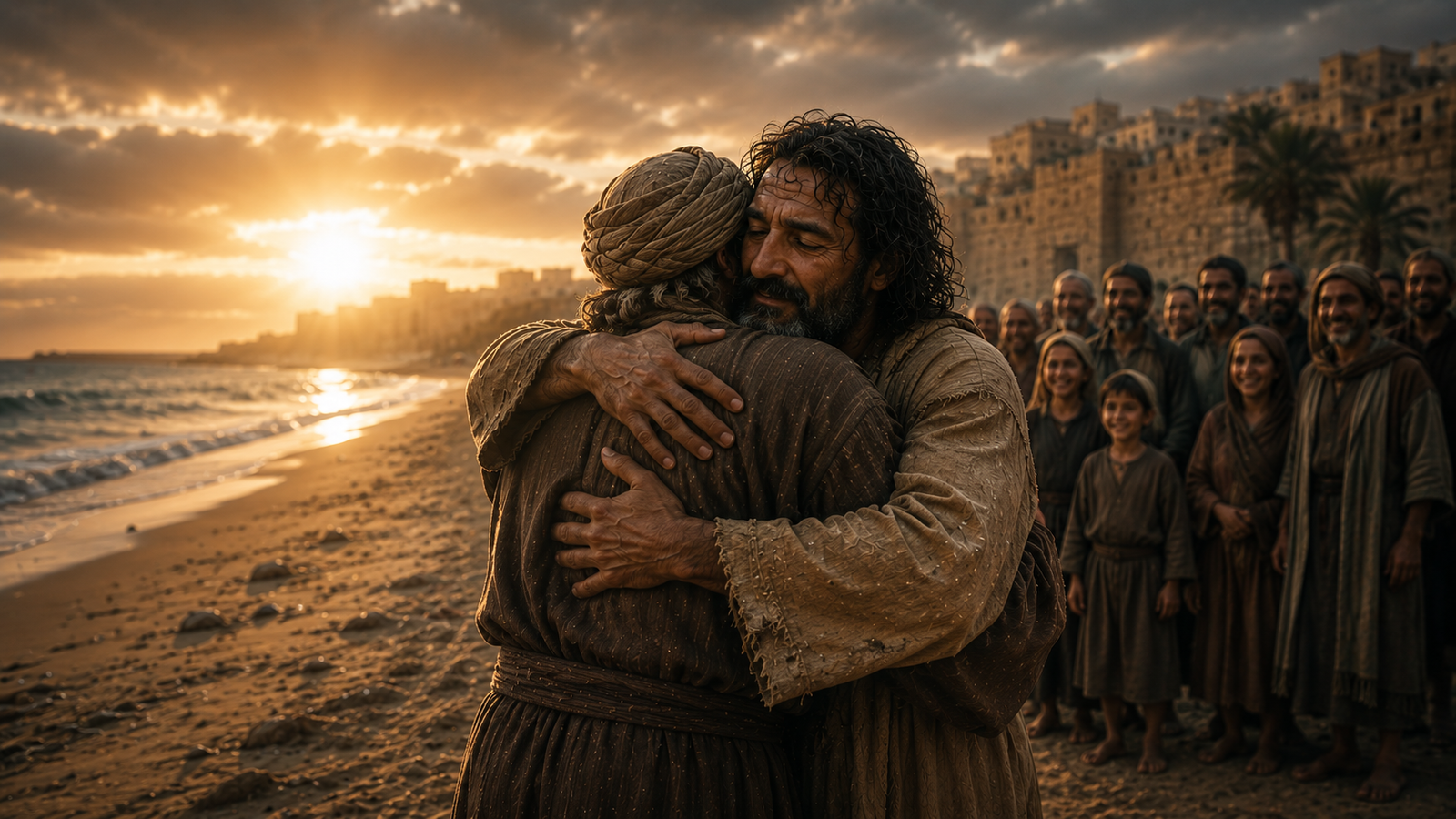
“All this is from God, who through Christ reconciled us to himself and gave us the ministry of reconciliation.” – 2 Corinthians 5:18
As I have reflected on Jonah’s story, one truth continues to stand above the rest. Grace was never meant to stop with us. God’s grace humbles, exposes, and sends us toward forgiveness. It sends us toward difficult conversations, broken relationships, and reconciliation whenever it is biblically possible. That may be one of the greatest differences between the kingdom of God and the culture we live in today.
A Culture That Encourages Us to Walk Away
There is a dangerous idea quietly spreading throughout our culture. It rarely presents itself as rebellion. Instead, it presents itself as wisdom, wears the language of healing, boundaries, and self-care. Also known as protecting your peace. Some of those ideas are good and necessary.
The Bible absolutely teaches wisdom, discernment, and healthy boundaries. There are situations involving abuse, manipulation, violence, or ongoing unrepentant sin where separation is not only appropriate, it may be necessary. That’s not part of my story.
Jesus sometimes withdrew from hostile crowds. Paul instructed believers to warn divisive people and, after repeated refusals to repent, to separate from them (Titus 3:10). Scripture never asks us to ignore evil or pretend that trust can be restored overnight, but somewhere along the way, something changed.
Today, relationships are often abandoned simply because they are difficult.
If someone disappoints us…They’re toxic.
If they hurt us…They’re cut off.
If they fail to meet our emotional needs…They’re removed from our lives.
The language sounds healthy. But I wonder if, in many cases, we’ve confused discomfort with danger. We’ve become remarkably good at protecting ourselves. I’m not sure we’ve become equally committed to pursuing reconciliation.
What Wise Counsel Caused Me to Reconsider
Some recent wise counsel that I received discussed a mindset that seems to be also growing in my own extended family. If a relationship becomes painful, walk away. If someone disappoints you, remove them. If someone repeatedly hurts you, cut them out of your life.
I found myself asking this question: Have we become so focused on protecting ourselves that we’ve forgotten the ministry Christ entrusted to us? Followers of Jesus are not only called to pursue healing. We are also called to pursue reconciliation whenever it is biblically possible.
That realization brought me right back to Jonah. God didn’t tell Jonah to avoid Nineveh. He sent him toward Nineveh. Not because Nineveh deserved it, but because that’s what grace does. Grace moves toward broken people.
The Ministry We Were Given
The Apostle Paul reminds us that followers of Christ have received something far greater than good advice for healthy relationships. We’ve been entrusted with a mission.
“All this is from God, who through Christ reconciled us to himself and gave us the ministry of reconciliation.” – 2 Corinthians 5:18
Notice what Paul doesn’t say. He doesn’t say we were given a ministry of avoidance, a ministry of self-protection, or a ministry of writing difficult people out of our lives. He says we have been given the ministry of reconciliation. That should cause every Christian to pause, because reconciliation isn’t simply something God did for us. It becomes part of who we are. People who have been reconciled to God become people who pursue reconciliation with others.
That doesn’t mean reconciliation always happens. Relationships involve more than one heart, but it should always be the desire of ours.
Not Every Separation Is Sinful
Before going any further, I think it’s important to make one thing clear. Not every broken relationship should be restored in exactly the same way. Scripture never calls us to enable abuse, ignore unrepentant sin, or abandon wisdom in the name of forgiveness. Healthy boundaries are not the opposite of biblical love. Sometimes they are an expression of it.
There are situations where distance protects people, where accountability is necessary, where trust must be rebuilt slowly over time, where reconciliation cannot occur because one person refuses to repent. The Bible acknowledges those realities, but boundaries should always serve the purpose of wisdom, not bitterness, protection – not punishment, healing – not revenge.
There is a tremendous difference between creating space for restoration and permanently closing the door on someone God may still be working to redeem. As followers of Christ, our goal should never simply be creating distance. Our goal should always be becoming more like Jesus.
This Isn’t Just Theology for Me
Everything I’ve written in this series has been deeply personal. This isn’t simply an article about Jonah. Or a review of Anthony Carter’s excellent book Running from Mercy. It’s about the season God has been walking me through.
Over the past year, I’ve experienced what it feels like to be labeled, misunderstood, judged, falsely accused. To watch people form conclusions about my character without asking difficult questions or allowing room for growth, repentance, or restoration.
I know what it feels like to have relationships I desperately wanted to save become increasingly distant. I know what it’s like to watch people choose separation over reconciliation, and if I’m honest, I also know how tempting it is to respond the same way, to write people off because they’ve written me off, to return accusation for accusation, to protect my heart by building walls so high that no one can ever hurt me again.
Those temptations are real, but every time I open the book of Jonah, every time I read the Gospels, every time I look at the cross, Jesus keeps calling me back to something higher. Not because truth or justice doesn’t matter, but because my calling as a follower of Christ is not to mirror the world’s way of handling conflict. My calling is to reflect the heart of Christ.
That doesn’t mean reconciliation is always possible. It doesn’t mean trust is instantly restored. It does mean I refuse to celebrate broken relationships, to rejoice when families become permanently divided, or refuse to believe that removing difficult people is always the mark of emotional health or spiritual maturity.
Because the God who pursued Jonah, the God who pursued Nineveh, and the God who pursued me, Is still in the business of pursuing broken people, and if I claim to follow Him, that pursuit should become part of my life as well.
The Heart of Reconciliation
The longer I follow Christ, the more convinced I become that reconciliation is at the very heart of the gospel. Before we were ever seeking Him, God sought us. Before we ever loved Him, He loved us. Before we ever repented, Christ died for us.
Paul reminds us:
“But God shows his love for us in that while we were still sinners, Christ died for us.” – Romans 5:8
That verse changes everything. God didn’t wait for us to deserve His love. He moved toward us while we were still running from Him. If that is how God treated us, shouldn’t that shape the posture of our own hearts? It doesn’t mean every relationship will be restored. It doesn’t mean trust is automatic. It doesn’t mean wisdom disappears, but it does mean that followers of Christ should always have hearts that desire redemption more than revenge and restoration more than rejection.
Forgiveness, Trust, and Reconciliation
One of the greatest lessons I’ve learned during this season is that these three words are not interchangeable. Forgiveness is something God commands me to give. Trust is something that must often be rebuilt over time. Reconciliation requires two humble hearts moving toward one another.
I cannot force someone to reconcile. I cannot make another person repent. I cannot heal every broken relationship, but I can refuse to let bitterness take root in my own heart.
Paul writes:
“If possible, so far as it depends on you, live peaceably with all.” – Romans 12:18
I love the honesty of that verse. “If possible.” “As far as it depends on you.” Paul recognizes that reconciliation is not always achievable, but he also reminds us that our responsibility is to keep our own hearts surrendered to Christ. That may be one of the hardest callings in the Christian life.
More Like Jesus Than Jonah
As I finished Running from Mercy, one final contrast became impossible to ignore. Jonah ran from the people God sent him to love. Jesus willingly came to the people who rejected Him. Jonah sat outside Nineveh hoping judgment would fall. Jesus stood outside Jerusalem and wept over the city. Jonah became angry when God showed mercy. Jesus stretched out His hands on the cross and prayed:
“Father, forgive them, for they know not what they do.” – Luke 23:34
The more I compare Jonah to Jesus, the more I realize the book of Jonah was never intended to leave us admiring Jonah. It was intended to make us long for someone greater, whose heart perfectly reflected the Father’s, who never ran from sinners, who willingly gave His life to rescue them. That is Jesus Christ, and that is who God is transforming us to become.
Grace Sends Us
As I’ve reflected on this series, one simple truth keeps rising to the surface. Grace changes everything. Grace humbles, exposes us, and sends us toward repentance, forgiveness. difficult conversations, and broken relationships. It compels us to extend mercy because we have first received mercy. That doesn’t mean every story ends the way we hope. It doesn’t mean every family is restored. It doesn’t mean every relationship is healed, but it does mean that followers of Christ should never stop believing that God is still in the business of redeeming broken people.
Sometimes, He begins by redeeming us.
The Question Jonah Never Answered
One of the most fascinating things about the book of Jonah is the way it ends. There is no neat conclusion. No record of Jonah’s response. No happy ending. Instead, God asks Jonah one final question. Then the book simply… ends. I don’t think that’s an accident. I believe God leaves the ending unfinished because the final question was never meant for Jonah alone. It was meant for every reader who would open this book centuries later.
It is meant for us.
Will we rejoice when God shows grace to people who don’t deserve it?
Will we extend mercy because we have first received mercy?
Will we pursue reconciliation whenever it is biblically possible?
Or will we continue running from the very grace that God has so freely poured out on us?
When I first picked up Running from Mercy, I expected to learn more about Jonah. Instead, I learned more about Brian. I saw places where pride had quietly taken root, where I wanted grace for myself but justice for others. Places where I had become more focused on changing my circumstances than allowing God to change my heart.
I’m still praying for my marriage.
I’m still praying for restoration with my family.
I’m still praying for opportunities to be the father God has called me to be.
Those prayers haven’t changed.
But something else has. More than ever before, I want God to make me look more like Jesus, not because I’ve mastered forgiveness, not because I always respond with grace, not because I’ve somehow figured it all out.
I write these words as someone who is still learning, growing, being convicted, transformed. Anthony Carter writes that the surprising and unstoppable grace of God brings a person to the end of themselves. I believe that’s exactly where God has been leading me, because the end of myself is where I have found more of Christ.
Perhaps that has been God’s purpose all along. May His grace continue to humble us and expose us, and may His grace send us into a broken world as ambassadors of reconciliation, pointing people to Jesus Christ, the One who first moved toward us when we were still running from Him.
📖 Surprised by Grace Series
✅ Part 1 – You Won’t Know the Grace of God Until You Stop Trying to Save Yourself
✅ Part 2 – When God’s Grace Offends Us
✅ Part 3 – Extending the Mercy We’ve Received