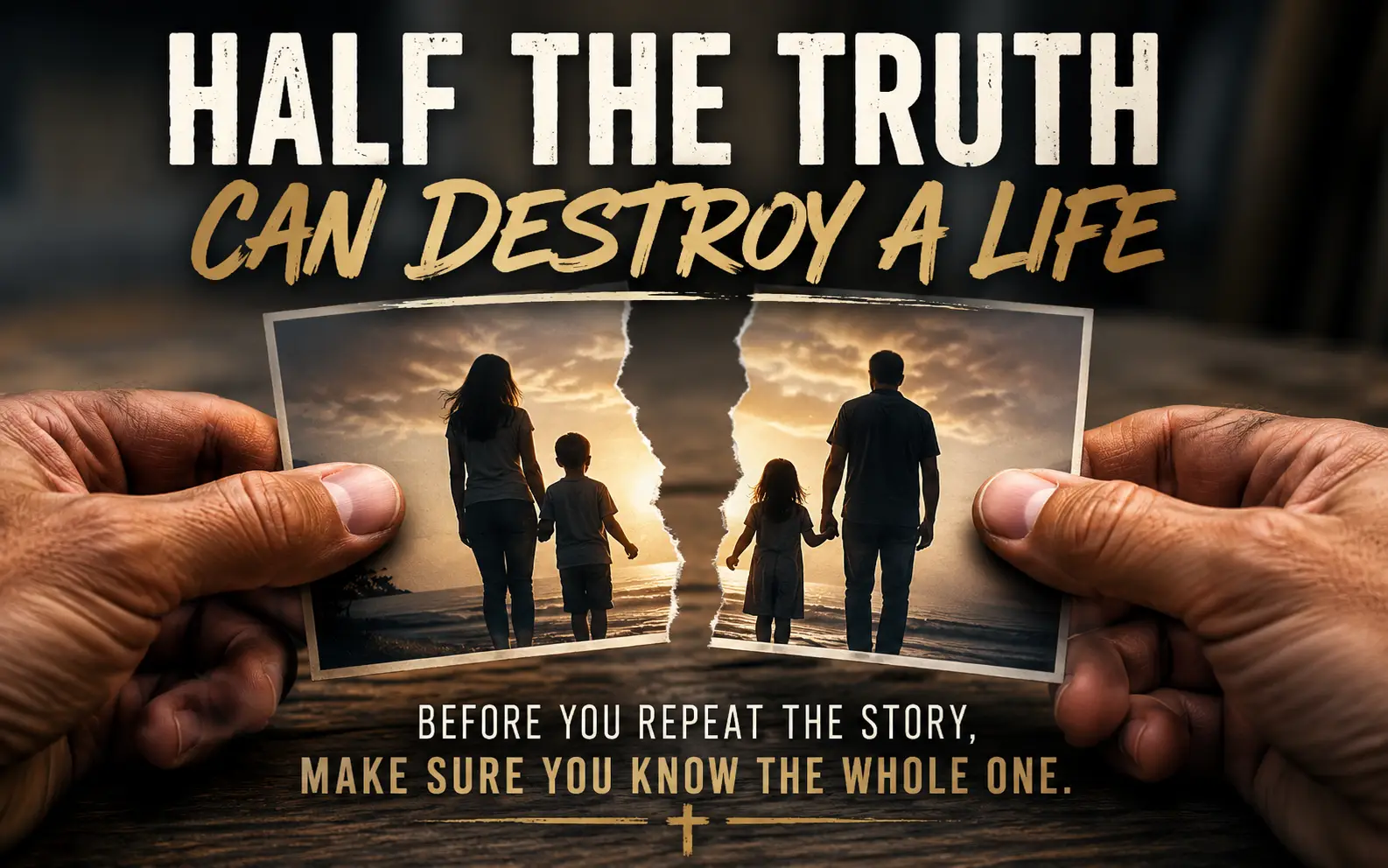
Before you repeat the story, make sure you know the whole one.
One of the most dangerous things in this world is a person who believes they know the full story after only hearing one side of it.
Read that again.
Because I’ve watched assumptions destroy relationships. I’ve watched accusations ruin reputations. I’ve watched people spread things they never verified, repeat things they never witnessed, and pass judgment on situations they never fully understood.
And what’s even harder to watch?
Sometimes it comes from people who claim to follow Christ.
That should bother us.
We live in a world now where people react before they think. They speak before they pray. They choose sides before they seek the truth. Somebody hears part of a story, adds emotion to it, mixes in opinions from five other people, and suddenly they’re delivering verdicts on somebody else’s life like they were personally appointed judge and jury.
And the damage that comes from that can be devastating.
Families divided. Friendships destroyed. Churches split apart. Careers ruined. People are emotionally crushed. Trust shattered.
All because somebody assumed they knew enough to speak on something they never truly took the time to understand.
The scary part is how normal this has become.
Negativity spreads faster than truth now. Outrage spreads faster than wisdom. And social media has turned many people into professional investigators with absolutely no investigation skills whatsoever. People see a post, hear a rumor, watch a clip taken out of context, or hear one emotional version of a story and immediately form a conclusion.
No prayer. No discernment. No grace. No patience. No desire to understand both sides.
Just a reaction.
And Christians are not immune to this at all.
In fact, sometimes Christians are some of the harshest people toward one another.
That hurts to say, but it’s true.
We are called to represent Christ, yet sometimes we represent anger better than grace. Sometimes we tear people down instead of helping restore them. Sometimes we talk about truth while completely forgetting love, mercy, wisdom, and humility.
We forget that every single one of us has sinned. Every single one of us has failed. Every single one of us has needed grace from God at some point in our lives.
Yet somehow it becomes easy to point fingers when the struggle belongs to somebody else.
Scripture speaks directly to this.
“Understand this, my dear brothers and sisters: You must all be quick to listen, slow to speak, and slow to get angry.”
Quick to listen. Slow to speak. Slow to anger.
Not the other way around.
But society has trained us backwards. Quick to react. Quick to assume. Quick to post. Quick to accuse. Quick to destroy.
And then once the damage is done, people move on like words don’t leave scars.
But they do.
“The first to speak in court sounds right until the cross-examination begins.”
That verse hits hard because it exposes something about human nature: the first story we hear often feels true emotionally before we ever evaluate whether it is actually a fact.
And emotions can blind people fast.
I’ve seen situations in life where if someone had simply slowed down, prayed, asked questions, listened carefully, and truly looked at the full picture, they would have realized things were not what they first appeared to be.
But instead, assumptions took over.
Assumptions are dangerous because once people create a false narrative in their mind, they often defend it harder than they seek the actual truth.
That’s where division grows. That’s where bitterness grows. That’s where darkness starts creeping in.
And honestly, I understand how easy it is to get pulled into that darkness myself sometimes.
When you see constant negativity, betrayal, division, hypocrisy, gossip, pride, and cruelty in the world long enough, it can start hardening your own heart, too, if you’re not careful.
I’ve had moments where anger rises up in me, watching people tear others apart without knowing the full story. Moments where I’ve wanted to react emotionally. Moments where frustration and disappointment start outweighing compassion.
But then I have to stop.
Pray.
Step back.
And remember who I’m supposed to represent.
Because as Christians, we cannot become the very thing we claim to stand against.
We cannot preach grace while refusing to give it. We cannot speak about truth while ignoring wisdom. We cannot claim to follow Christ while enjoying watching people fall apart.
That’s not Christ-like. Not even close.
Jesus dealt with people in truth, yes. But also in compassion, patience, wisdom, and mercy. He saw people deeper than their worst moments. He understood hearts. He restored people society wanted to destroy.
And maybe that’s part of what’s missing right now.
Too many people want to expose. Too few want to restore.
Too many people want to win arguments. Too few want healing.
Too many people speak to be heard. Too few listen to understand.
“Don’t use foul or abusive language. Let everything you say be good and helpful, so that your words will be an encouragement to those who hear them.”
Every word you speak about another person is either building something or tearing something down.
There is no neutral ground.
Words don’t evaporate after you say them. They land somewhere. They stick to people. They follow them into their car ride home, into their bedroom at night, into the quiet moments when nobody else is around. Words spoken carelessly about someone’s character, their marriage, their failures, their choices — those words do damage that sometimes takes years to undo.
And sometimes they never get undone at all.
So I want to ask you something directly.
Before you repeat what you heard, did you verify it? Before you share that story, do you actually know the full picture? Before you pass judgment, have you even prayed about it?
Because the truth is, most of us have been on the wrong side of this at some point. Most of us have said something about someone before we had the full story. Most of us have assumed, repeated, or judged when we should have paused, prayed, and listened.
I know I have.
And I also know what it feels like to be on the receiving end of it — to have your name passed around by people who never once asked for your side. To watch a narrative form about your life that had almost nothing to do with reality. To see people you trusted accept a half-truth as the whole story and never look back.
It’s devastating in ways that are hard to put into words.
But here’s what I’ve learned through all of it.
God sees the full picture. Always. Every time. He is never fooled by a one-sided story. He never rules based on incomplete information. He never delivers a verdict without perfect understanding.
And He calls us to pursue that same standard — not perfectly, but intentionally.
Slow down before you speak. Pray before you conclude. Seek truth before you share. Extend grace before you judge.
Because one day it might be your name being passed around. Your story is being told by someone who only heard half of it. Your life is being judged by people who never even asked what you were going through.
And in that moment, you’ll want someone in the room who still believes in getting the full story.
Be that person.
Half the truth isn’t just incomplete.
Half the truth can destroy a life.