I wear a bracelet every day.
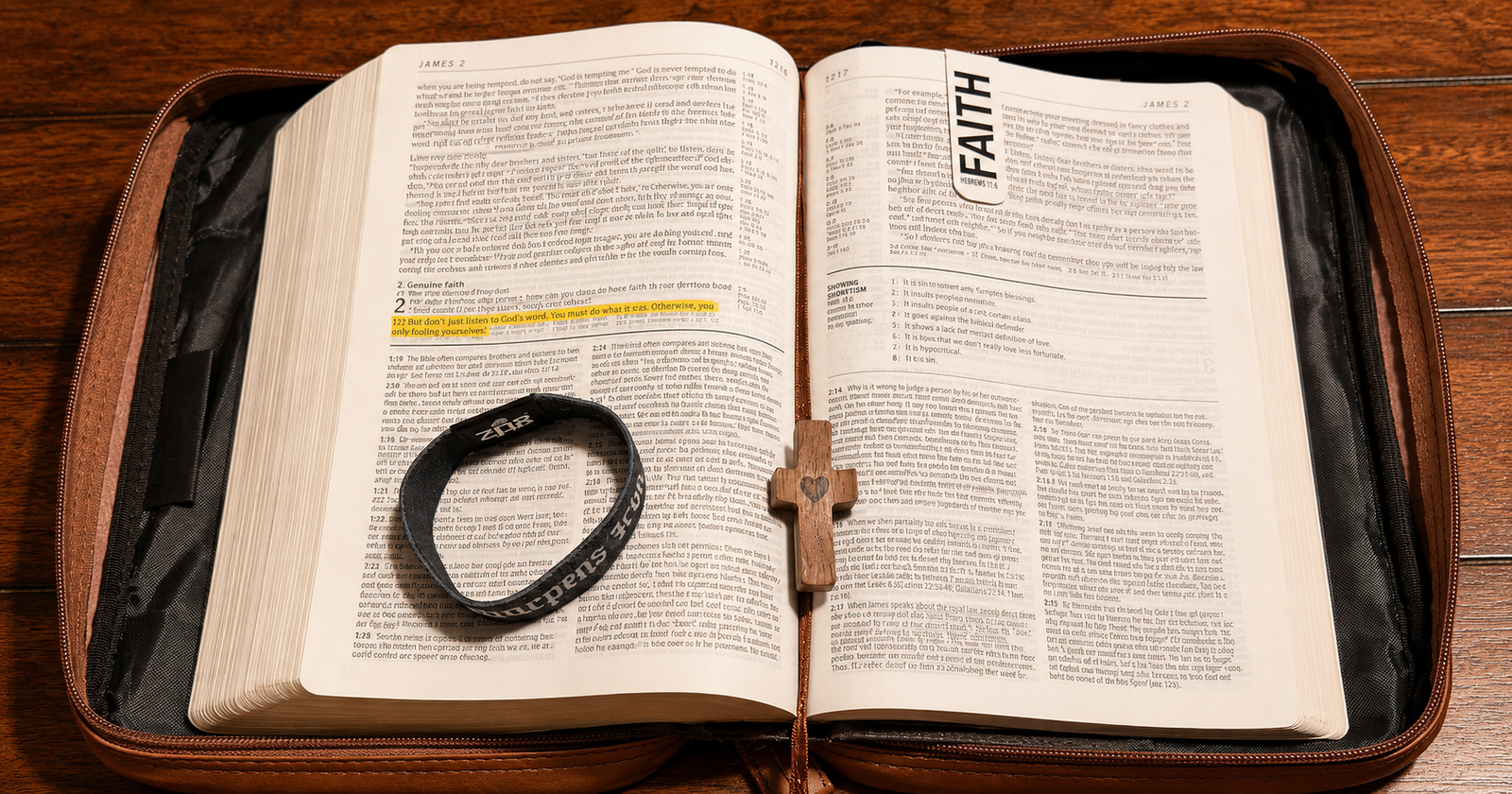
It has become part of my daily routine, just like my watch, wallet, and keys. But this bracelet is not something I wear for style. It is not jewelry to me. It is a simple elastic band with the words “Iron Sharpens Iron” printed on it.
Inside that bracelet is a small chip. I take my phone, scan it, and Scripture comes up for me to read right there in the moment.
Any time of day.
At work.
At home.
In the middle of stress.
When my mind is busy.
When I need a reminder.
When I do not even realize yet how badly I need one.
And what is amazing to me is how often the first verse that comes up is exactly what I needed to read.
Not close.
Not random.
Not just “that was nice.”
It hits directly. Like God already knew what was going on in my mind before I ever touched my phone. Like He knew what I was carrying, the conversation I had just had, the thought I had not said out loud, or the prayer I had barely formed.
And the truth is, He did know.
Brian has one too. I gave him one when we met to talk about Faith For Real Life, and that means something to me. He is my nephew, but on this venture he is not just family helping family — he is my partner in Christ.
The bracelet is not named “Iron Sharpens Iron” by accident. Proverbs 27:17 (NLT) says it straight: “As iron sharpens iron, so a friend sharpens a friend.” That is what Brian has been for me in this — not just a co-author, but somebody who sharpens me, and I hope I do the same for him.
And if Faith For Real Life has a toolbox, the Bible is not one of the tools in it. It is the main one. Without Scripture, this would just be two guys sharing opinions on the internet, and the internet already has enough of that disaster.
I Still Struggle With This Too
Here is the part I almost did not write.
I run a faith blog. I wear a Scripture bracelet on my wrist every single day. And I still struggle to read my Bible consistently.
My biggest excuse is time. I tell myself I am too busy, work runs long, the day gets away from me — and most days that is not even true. It is not that I do not have the time. It is that I have not organized and prioritized my time to make room for it. That is not a scheduling problem. That is a heart problem wearing a scheduling problem’s clothes.
My second struggle is worse, honestly. I will read a passage, close the Bible, and twenty minutes later I could not tell you three things I just read. The words go in and slide right back out. I forget. I do not retain it the way I want to.
If you feel that same tension — wanting to read more, meaning to read more, and still watching the day slip by without opening it — you are not broken, and you are not alone. This is not a post from a guy who has this figured out, handing down wisdom from the mountaintop. This is a guy who wears a Bible verse on his wrist every day and still has to fight for it. That is the battle. It does not go away just because you get more serious about your faith. You just get better at fighting it.
So let us fight it together.
Where Do I Even Start Reading the Bible?
A lot of people want to read the Bible but do not know where to begin.
They open it up and see names they cannot pronounce, places they have never heard of, laws they do not understand, and before long they close it and feel like they failed before they even started.
If that has ever been you, you are not alone in that either.
The Bible can feel overwhelming at first. It is a big book. History, poetry, prophecy, letters, wisdom, warnings, miracles, parables, genealogies, commands, promises — things that take time to understand.
But you do not have to understand everything to begin. You just have to start.
God is not asking you to become a Bible scholar before you open the Bible. He is inviting you to spend time in His Word so you can know Him better, learn His ways, and let His truth shape your life.
Psalm 119:105 (NLT) says it plainly: “Your word is a lamp to guide my feet and a light for my path.”
That means Scripture is not just information. It is direction. And in a world full of noise, opinions, arguments, and distractions, we need direction.
Start With the Book of John
If you are new to reading the Bible, start in one of the four Gospels — Matthew, Mark, Luke, or John.
For me, I would start with John.
John brings you right to Jesus. It shows who He is, why He came, how He loved, what He taught, and what it means to believe in Him.
Do not start by trying to figure out every difficult passage in the Old Testament on day one. Start by looking at Jesus.
Read John slowly. Read a section and ask yourself:
What does this show me about Jesus?
What does this show me about people?
What is God trying to teach me here?
How does this speak into my real life?
That is a good place to begin.After John, three more places worth your time: James, direct and practical about faith showing up in how we actually live — James 1:22 (NLT) puts it plainly: “But don’t just listen to God’s word. You must do what it says. Otherwise, you are only fooling yourselves.” Psalms, honest about fear, grief, and hope alongside worship. Proverbs, practical wisdom for daily choices, work, anger, and character.
You do not have to read all of them at once. Just start somewhere and stay with it.
What If I Forget What I Read?
This is the question I wrestle with the most, so let me answer it the way I would want someone to answer it for me.
Forgetting a verse does not mean the verse did not work. Seed does not stop being seed just because you cannot see it grow yet. Some of what you read is not for retaining right now — it is for planting.
Still, here is what actually helps me:
Write down one thought. Not a page of notes. One sentence about what you read. That single sentence does more for retention than re-reading the chapter three times.
Use the search feature on your Bible app. If you are anxious, search “anxiety.” Sad, search “sadness.” Afraid, search “fear.” Discouraged, search “hope.” You may be surprised how quickly Scripture meets you right where you are — and a verse you found because you needed it sticks a lot better than one you read because you were supposed to.
Say it out loud once. Speaking a verse, even quietly, uses a different part of your memory than silent reading does.
Let a bracelet, a devotional, or a friend bring it back around. This is exactly why my bracelet works for me — it is not a one-time read, it is a repeat exposure. Same with my morning devotional, and same with conversations with Brian, where he will bring up a verse that fits exactly what we are discussing, like God is using the conversation to get my attention twice.
I use the NLT Study Bible for everyday language, and I also keep my Scofield King James Version close, because it has history and familiarity for me after a lot of years. Find a translation you can actually understand. You are not less spiritual for needing language that is clear.
The goal is not a perfect memory. The goal is a repeated encounter.
Hebrews 4:12 (NLT) says it stronger than I ever could: “For the word of God is alive and powerful. It is sharper than the sharpest two-edged sword… It exposes our innermost thoughts and desires.”
Scripture is not dead words sitting on a page waiting for you to memorize them perfectly. It is alive. It works on you even when you cannot immediately recite it back.
Start Small, Stay Honest
The biggest mistake I see — and the biggest mistake I make — is trying to do too much too fast. Ten chapters a day, a full study plan, spiritual discipline overnight. Three days later, behind, discouraged, ready to quit.
Five honest minutes in God’s Word beats an hour-long plan you abandon after a week.
Not perfection. Consistency. That is the whole target.
Just Begin
If you do not know where to start reading the Bible, start with John. Read a little each day. Then James. Then Psalms. Then Proverbs.
Write one sentence down. Search a feeling instead of a book and chapter. Say a verse out loud once. Let something — a devotional, a friend, a reminder on your wrist — bring it back around a second time.
Most of all, do not wait until you feel ready, and do not wait until you have beaten the excuses first. I have not beaten mine. I still have to fight for the time, and I still forget more than I would like to admit. I am not writing this from the other side of the struggle. I am writing it from inside it, right alongside you.
God can use one verse at the right moment to speak into something you have been carrying for years. He has done it for me — sometimes through a bracelet I almost forget I am wearing, until the moment I need it most.
He can do it for you too. Right now, before you close this page: open the Bible, read one page of John. That is the whole assignment.
If you want a place to keep going after that, “How Many Times Can You Be Broken and Put Back Together?” shows what happens when Scripture meets you in the middle of the worst seasons, not just the easy ones.
And if the prayer below feels harder to say than it should, “When You Don’t Know How to Pray, Pray Anyway” walks through exactly that struggle.
A short prayer if you need words to start with:
God, I don’t always know where to begin with You, and I don’t always retain what I read or make the time I should. Meet me in Your Word anyway — in the quiet, in the noise, in the moments I don’t even know I need You yet. Open my eyes to what You want to show me, and help me come back to it again tomorrow. Amen.
Keep Reading
Explore more articles about prayer and spiritual growth
A question to consider: What simple reminder could help you return to Scripture when the day becomes noisy or distracted?