
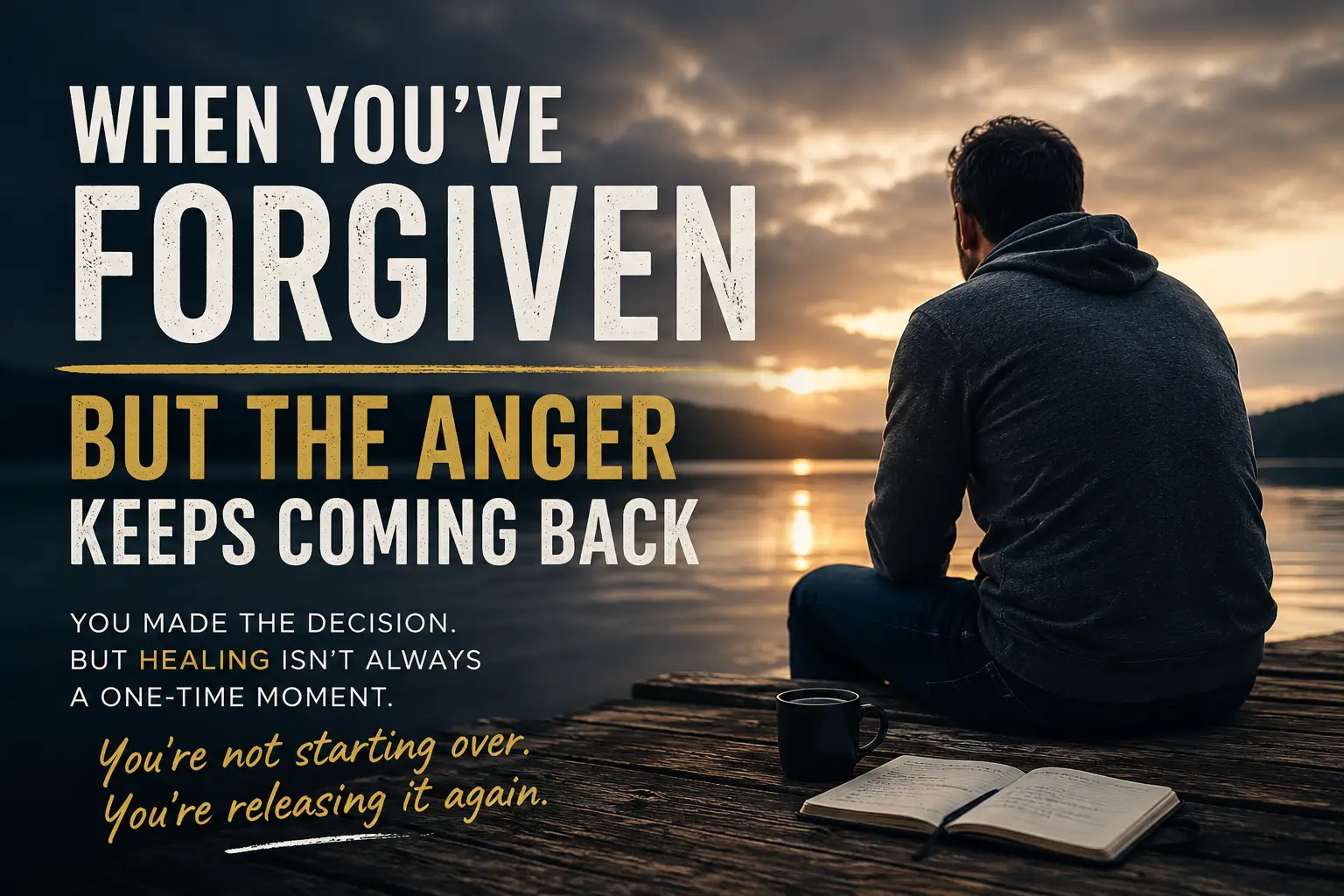
You forgave them.
At least you thought you did.
You had the prayer. You made the decision. You told God you were letting it go.
And for a while, it even felt like you had.
Then something hit you out of nowhere.
A song. A memory. A name on your phone. A place you drove past. A Tuesday afternoon when your mind got too quiet.
And suddenly it all came rushing back.
The anger. The hurt. The replaying of what happened. The tightness in your chest you thought was gone.
And now you’re sitting there wondering: Did I ever really forgive them at all?
That question alone has trapped a lot of people in guilt they were never supposed to carry.
Because here’s what nobody explains clearly enough:
Forgiveness is not the absence of pain. It’s not the absence of memory either.
Forgiveness is a decision. A hard one. And like most decisions that actually matter in life, you usually don’t make it just once. You make it again and again. Every time the memory surfaces. Every time anger tries to rebuild a home inside your heart.
That doesn’t mean your forgiveness wasn’t real. It means your wound was.
⸻
A lot of people quietly believe forgiveness should feel instant. Pray once, release it once, never struggle with it again.
But that’s not usually how healing works. Not with betrayal. Not with abandonment. Not with words that cut deeper than the person realized when they said them.
Real wounds ache sometimes. Even healed ones.
You can break a bone years ago and still feel it when the weather changes. You can have surgery, recover, move on with your life — and still feel soreness in certain moments. Nobody calls that failure.
But when emotional pain resurfaces? People panic. They assume: If this still hurts, I must not have forgiven.
That’s not true. It hurts because it mattered. It hurts because you’re human. Some things leave marks that go deeper than people can see.
And God knows that.
⸻
Paul put it this way:
— Ephesians 4:31 (NLT)
He doesn’t say never feel hurt again. He says get rid of bitterness.
That wording matters.
Because getting rid of something is often a process. Not an instant emotional deletion.
Sometimes forgiveness looks less like a lightning bolt and more like repeatedly laying something down before God — until eventually your soul stops gripping it so tight.
The anger returning doesn’t mean you failed. It means you’re still healing. Those are two very different things.
⸻
Here’s what usually happens when a wound gets triggered again: shame moves in fast.
I shouldn’t still feel this. I thought I dealt with this already. Why am I back here?
But maybe you’re not back at the beginning. Maybe you’re just farther into the process than it feels right now.
Healing isn’t a straight line. Some days you feel free. Some days it stings again. Some days you genuinely don’t think about it at all — and then one random moment cracks the door open and the emotions rush back like they never left.
That’s why forgiveness has to be rooted in something more solid than how you feel on a given day. Because feelings are unstable. Some days they cooperate, some days they don’t. Forgiveness built only on emotion will collapse every time emotions shift.
But forgiveness rooted in obedience to God? That survives even the hard days.
⸻
There’s one more thing worth saying — something people tend to avoid.
Sometimes the anger comes back because something current touched the old wound. Someone spoke to you the same way. Someone dismissed you again. Someone made you feel small again. The present echoed the past.
Pay attention to that.
Not so you can stay offended. Not so you can hold onto bitterness. But so you can be honest with yourself about where healing still needs to happen — and where wisdom might still call for some boundaries.
Forgiveness doesn’t mean pretending something was okay. It doesn’t mean automatic trust. And it doesn’t mean you keep putting yourself in position to take the same hit over and over.
Jesus forgave people constantly. He also walked away from certain crowds.
Both things can be true at the same time.
⸻
So what do you actually do when the anger comes back?
You don’t panic. You don’t condemn yourself. You don’t assume your forgiveness was fake.
You acknowledge the pain honestly. You bring it back before God. And you release it again.
Not because you’re weak. Because you’re healing.
“He heals the brokenhearted and bandages their wounds.”
— Psalm 147:3 (NLT)
Bandages are for wounds that are still healing. They’re not a sign of failure — they’re a sign someone is taking care of you.
So if the anger came back today, you’re not starting over. You’re just releasing it again. And every time you choose to place it back in God’s hands instead of letting it take root in your chest — that’s real faith.
Not the kind that looks good. The kind that keeps going.







2 Responses
Forgiveness is truly a process, some times taking years to complete. The cycle at least takes 490 time, but I’d say lots more than that.
Also, Ephesians 4:32 is the next best part of the passage. Be ye kind, one to another, tenderhearted, forgiving one another, even as God, for Christ’s sake has forgiven you.
My high school math teacher and principal, Mr. Bova, had a great song he made up for this verse that I still regularly sing…
That’s such a great perspective, and honestly very true. Forgiveness really is a process sometimes, not just a one-time moment. I think a lot of people feel guilt when the pain or anger comes back, but healing and forgiveness often happen layer by layer over time.
And yes, Ephesians 4:32 is such a powerful continuation of that passage. That verse carries a lot of weight when you truly sit with it. I love that your teacher made a song from it too. Funny how certain things stay with us for life when they’re tied to truth and meaning.
Really appreciate you sharing this.