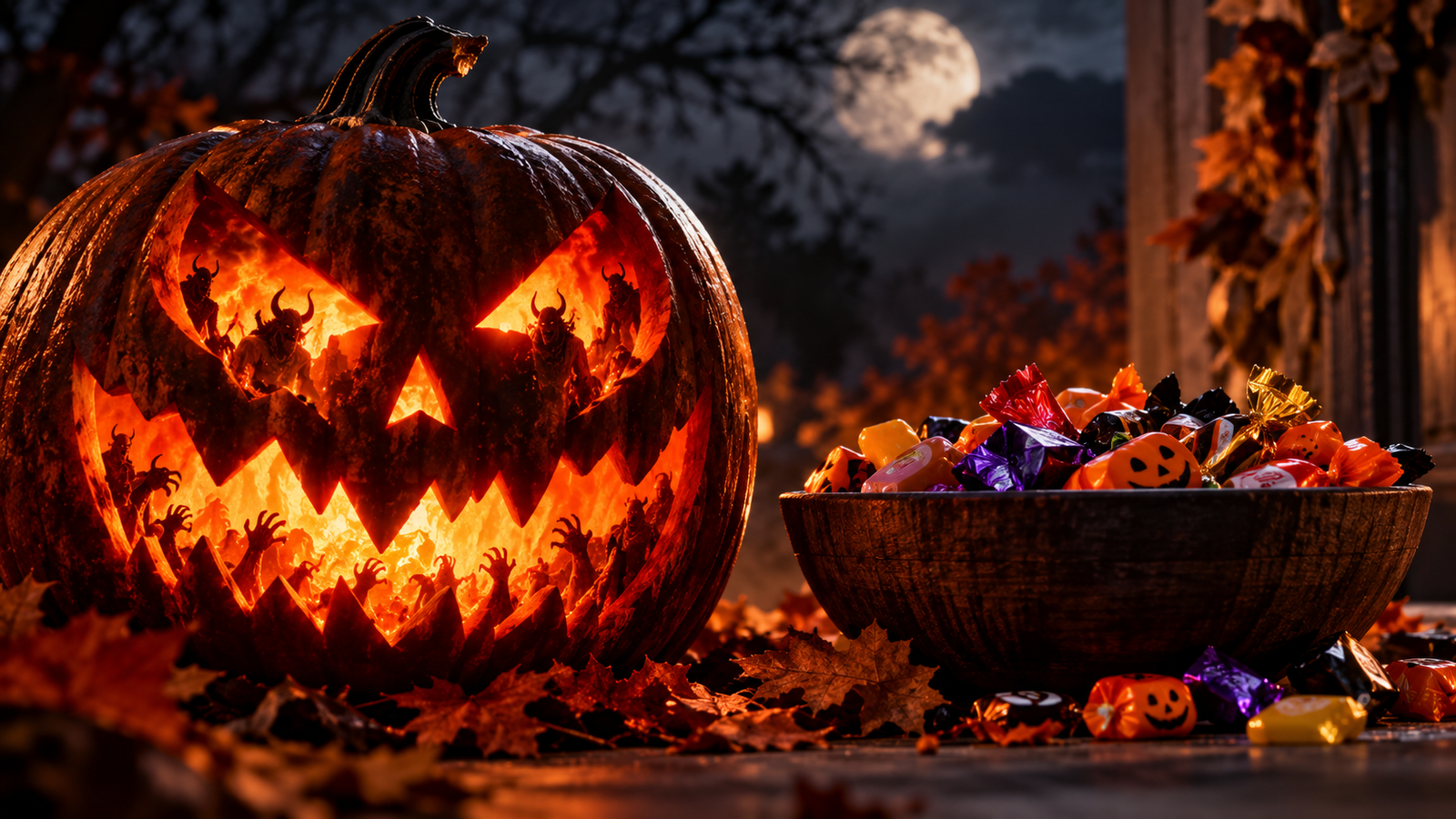
Walk through almost any store in the past few months and take a good look at what we’re celebrating. Demons. Witches. Ghosts. Corpses. Gravestones. Severed body parts. Skeletons. Possession. Death. Some houses no longer have a pumpkin and a scarecrow sitting on the porch, they look like elaborate depictions of the supernatural from hell and yet we call it harmless fun.
Halloween has also become enormous business. According to the National Retail Federation, Americans spent a record $13.1 billion on Halloween in 2025, including approximately $4.2 billion just on decorations. That doesn’t make Halloween bigger than Christmas financially, as is sometimes claimed, but it does demonstrate just how enormous the Halloween industry has become. We’re spending billions of dollars every year on costumes, candy and decorations, and an extraordinary amount of that imagery revolves around death, fear, witchcraft, demons and darkness.
I’m not suggesting that the little boy dressed like Spider-Man collecting Reese’s Cups from his neighbors is worshiping Satan. That used to be my son. I’m not suggesting that carving a smiling face into a pumpkin opens some kind of doorway to the demonic, and I’m certainly not suggesting that every Christian family who allows their children to trick-or-treat is intentionally celebrating evil.
I’m asking a different question: Why has our culture become so comfortable celebrating the imagery of hell and darkness?
Scripture presents Satan, demons, witchcraft, divination, death and spiritual darkness as serious realities, not decorations. Yet for several weeks every year, our culture turns many of those very things into entertainment. We hang corpses from trees, put demons on our porches, decorate our yards like graveyards, dress like witches and evil spirits, pay money to be frightened by depictions of murder and demonic possession, and then dismiss all of it with three words: “It’s just Halloween.”
Maybe it is worth asking whether Christians should look at it differently.
I realize I may be in the minority here, but as a Christian, I don’t believe Halloween is something we should celebrate. At the same time, I don’t think the issue is as simple as saying that costumes, candy or pumpkins are inherently sinful. There is an enormous difference between enjoying a beautiful fall evening with your children and deliberately celebrating darkness, death, demons, witchcraft and the occult.
For me, the question isn’t simply, “Is Halloween pagan?” The better question is: What am I celebrating, what am I representing, and does it honor Christ?
Where Did Halloween Come From?
The history of Halloween is more complicated than it is sometimes presented, even in Christian circles. It would be inaccurate to say that everything associated with modern Halloween came directly from one pagan religious festival. Halloween developed over many centuries from a mixture of customs and traditions. However, there is absolutely a pre-Christian component to its history.
The Library of Congress traces part of Halloween’s development to Samhain, an ancient Celtic observance marking the end of summer and the beginning of the darker portion of the year. It was associated with beliefs concerning the dead and the supernatural world. Over time, some of those customs became intertwined with Christian observances surrounding All Saints’ Day, also called All Hallows’ Day, on November 1. The evening before became known as All Hallows’ Eve, which eventually became the word Halloween.
So it isn’t historically accurate to say that everything people do on Halloween today is simply an unchanged pagan ritual. Modern Halloween is a mixture of traditions that developed over a very long period of time. Still, history matters. More importantly for Christians, what we choose to celebrate matters.
The Darker Side of Halloween’s History
There is another part of Halloween’s history that I don’t think Christians should simply dismiss as harmless folklore. Ancient Celtic religion included beliefs and practices involving spirits, divination, sacrifice and interaction with the supernatural world. Samhain was associated with a period when the boundary between the human and supernatural worlds was believed to become unusually permeable. Traditions developed around supernatural beings wandering among the living, offerings of food and drink, bonfires and disguises.
We need to be careful with our terminology here. Historically, it would be inaccurate to simply say that ancient Celts were consciously “worshiping Satan” as Christians understand Satan. They followed their own pagan religious beliefs and worshiped their own deities. But from a biblical perspective, pagan spiritual practices are not something Christians are told to regard as spiritually neutral.
Deuteronomy 18:10–12 specifically condemns divination, fortune-telling, interpreting omens, sorcery, mediums, necromancy and attempts to inquire of the dead. God was commanding Israel not to adopt the spiritual practices of the pagan cultures surrounding them.
The New Testament continues that distinction. When people in Ephesus came to Christ, Acts 19:18–20 tells us that those who had practiced magic brought their books together and publicly burned them. They didn’t simply add Jesus to their existing spiritual practices. Following Christ meant abandoning practices incompatible with their new allegiance to Him.
Paul goes even further in 1 Corinthians 10:20–21 when he says that pagan sacrifices were offered “to demons and not to God,” and warns believers against participating both in the Lord’s table and the table of demons. That doesn’t mean we need to sensationalize Halloween or invent historical connections that aren’t there. Scripture itself gives Christians plenty of reason to take occult practices seriously.
What About Sacrifice?
Sacrifice was part of ancient Celtic religious practice as well. Historical accounts associate Samhain with the slaughter or sacrifice of animals, particularly cattle. Ancient Greek and Roman writers also accused Celtic peoples and Druids of practicing human sacrifice. This is another area where Christians should be careful about repeating sensational claims as established history. Ancient Roman writers weren’t necessarily neutral observers of Celtic culture, and archaeological discoveries such as violently killed “bog bodies” have produced considerable debate among historians about whether particular individuals were executed, murdered or ritually sacrificed.
In other words, we shouldn’t confidently claim that “Druids sacrificed people every Halloween.” The historical evidence doesn’t justify saying that. What we can responsibly say is that sacrifice was part of Celtic religious practice, ancient sources associate Druids with sacrificial rituals, and animal sacrifice has been associated historically with Samhain. We don’t need to exaggerate the evidence to recognize that these were religious practices completely foreign to biblical worship.
Scripture again provides Christians with a sobering perspective. Psalm 106:35–38 describes Israel adopting the practices of pagan nations and says they “sacrificed their sons and their daughters to the demons.” God repeatedly commanded His people not to imitate pagan worship. That principle hasn’t changed.
The Strange History of the Jack-o’-Lantern
Even the familiar jack-o’-lantern has a strange history. The original jack-o’-lantern wasn’t a pumpkin at all. Pumpkins are native to the Americas, so ancient Druids in Ireland certainly weren’t carving pumpkins. In Ireland and Scotland, people carved frightening faces into turnips and other root vegetables, with traditions developing around frightening away wandering or evil spirits.
Later Irish folklore connected the lantern with the story of Stingy Jack, a man who supposedly repeatedly tricked the Devil. According to the legend, when Jack died, he was accepted by neither Heaven nor Hell and was condemned to wander the earth carrying a burning coal inside a hollowed-out turnip. When Irish immigrants brought their traditions to America, pumpkins were plentiful and considerably easier to hollow out and carve. Eventually, the pumpkin jack-o’-lantern became one of the most recognizable symbols of Halloween.
Does that mean carving a smiling face into a pumpkin with your children is an act of demon worship? No. Most families carving pumpkins today probably know nothing about Stingy Jack, ancient Celtic religion or attempts to frighten away spirits. But I still think Christians should know the history.
There is a difference between carving pumpkins with your children as a fun fall activity and deliberately embracing imagery that celebrates demons, witchcraft, death and the occult. Knowing where traditions came from gives Christian parents an opportunity to make thoughtful decisions instead of simply doing something because everybody else does it.
Satan Doesn’t Need a Red Suit and Pitchfork
Perhaps the bigger issue for me isn’t whether every Halloween tradition can be traced directly to pagan worship. It’s how comfortable our culture has become with things Scripture tells Christians to take seriously. Demons have become decorations. Witchcraft becomes entertainment. Ouija boards become games. Corpses hang from trees. Skeletons crawl across front yards. Demonic figures stand on porches. Haunted attractions deliberately immerse people in images of possession, murder, torture and death. Then we tell ourselves, “It’s just Halloween.”
Scripture doesn’t portray Satan and demons as cartoon characters. 1 Peter 5:8 warns, “Your adversary the devil prowls around like a roaring lion, seeking someone to devour.” Ephesians 6:12 reminds Christians that “we do not wrestle against flesh and blood,” but against spiritual forces of evil. 2 Corinthians 11:14 warns that “even Satan disguises himself as an angel of light.”
That doesn’t mean Christians should be terrified of Satan. Quite the opposite. Christ has already defeated the powers of darkness. Colossians 2:15 tells us that Christ “disarmed the rulers and authorities and put them to open shame, by triumphing over them.” But there is a difference between not fearing darkness and celebrating it.
That’s where Halloween increasingly troubles me. Why would people who have been called out of darkness and into Christ’s light want to decorate their homes with representations of the very darkness Christ defeated? 1 Peter 2:9 says that God called us “out of darkness into his marvelous light.” Perhaps Christians should look different precisely because we belong to the Light.
When Decorating Becomes Celebrating Darkness
This may be the part of modern Halloween that bothers me most. There is something strange about the extent to which our culture now decorates homes and yards with images of death. Walk through Home Depot or almost any major retailer during the fall and you’ll find enormous skeletons, corpses, witches, demons, tombstones and gruesome displays designed specifically to frighten people.
Again, I’m not suggesting that putting a pumpkin on your porch is sinful. I love fall. Pumpkins, colorful leaves, corn stalks, hay bales, apples, harvest decorations and scarecrows are part of what makes the season enjoyable. But there is a difference between celebrating autumn and celebrating darkness.
Philippians 4:8 tells Christians to dwell on whatever is “true,” “honorable,” “just,” “pure,” “lovely” and “commendable.” Ephesians 5:8 reminds us, “For at one time you were darkness, but now you are light in the Lord. Walk as children of light.” Those verses make me ask a simple question: Why should Christians enthusiastically participate in a cultural fascination with darkness simply because everyone else does?
But What About Costumes and Trick-or-Treating?
This is where I think Christians need wisdom rather than simply creating another list of rules. Personally, I don’t have a problem with a little kid dressing up like a firefighter, princess, dinosaur, baseball player or superhero and getting candy from the neighbors. Dressing up is fun. Candy is fun. Walking through the neighborhood with your family can be fun. None of those things, by themselves, constitute occult worship.
But there is a difference between dressing your five-year-old like Batman and deliberately dressing as a demon, glorifying serial killers, celebrating witchcraft or immersing yourself in gore and death. That distinction matters to me.
Paul gives us a useful principle in 1 Corinthians 10:31: “So, whether you eat or drink, or whatever you do, do all to the glory of God.” That’s a much more challenging question than simply asking, “Am I allowed to do this?” Can I do this to the glory of God?
When children are very young, parents may decide that dressing up and collecting candy is innocent fun. I understand that. But as children grow older, I think Christian parents have an opportunity, and a responsibility, to explain where some of these traditions came from, what occult imagery represents, what Scripture teaches about darkness and spiritual warfare, and why our family may choose to do certain things differently.
The goal shouldn’t simply be, “Halloween is bad, so you can’t have fun.” The goal should be discipleship. We should be raising children who eventually know how to examine culture for themselves through the lens of Scripture.
We Don’t Have to Cancel Fall
Rejecting Halloween doesn’t mean Christians need to sit inside with the curtains closed every October 31. Fall is one of the best times of the year. Go hiking. Have a bonfire. Visit an apple orchard. Carve pumpkins. Drink cider. Take the kids through a corn maze. Have friends over. Go on a hayride. Hold a harvest party. Have a church fall festival. Cook outside. Enjoy God’s creation as the leaves change.
There are plenty of ways for Christian families to enjoy autumn without haunted houses, demons, witches and gore. Instead of simply taking something away from our children, we can replace it with something better.
And there is actually something else Christians can remember on October 31, something far more significant to our faith.
October 31 Is Reformation Day
On October 31, 1517, an Augustinian monk and theology professor named Martin Luther sent his famous 95 Theses, challenging abuses surrounding the sale of indulgences. According to the traditional account, Luther also posted the theses on the door of the Castle Church in Wittenberg, Germany. Historians continue to debate whether the famous hammer-and-nails scene happened exactly as later tradition describes it, but October 31, 1517 remains the date traditionally associated with the beginning of the Protestant Reformation.
Luther wasn’t planning to create the Protestant church that morning. His theses were originally intended for theological debate, particularly concerning indulgences. But the recently developed printing press allowed his arguments to spread rapidly, and the controversy became part of a much larger movement that transformed Christianity throughout Europe.
The Reformation was also much larger than Martin Luther. Men such as John Calvin, Huldrych Zwingli, William Tyndale and many others played significant roles, and earlier reformers had already challenged corruption and called the church back toward biblical authority. Protestant Christianity wasn’t suddenly invented on October 31, 1517, but the date represents an enormously important turning point.
At the heart of the Reformation were questions that still matter today: How is a sinner made right with God? What authority does Scripture possess? Is salvation something we earn, purchase or deserve, or is it God’s gift of grace received through faith in Jesus Christ?
Those are questions worth teaching our children. Ephesians 2:8–9 says, “For by grace you have been saved through faith. And this is not your own doing; it is the gift of God.” Romans 1:17 declares, “The righteous shall live by faith.” And 2 Timothy 3:16–17 reminds us that “All Scripture is breathed out by God” and equips God’s people for every good work.
The Reformers eventually summarized several central Protestant convictions in what became known as the Five Solas: Sola Scriptura – Scripture alone; Sola Fide – Faith alone; Sola Gratia – grace alone; Solus Christus – Christ alone; and Soli Deo Gloria – to the glory of God alone.
Those are considerably more important things to teach our children than how frightening we can make the front yard.
Something Better to Celebrate
I’m not interested in becoming the Halloween police. Christians are going to reach different conclusions about costumes, candy, pumpkins and trick-or-treating. Romans 14 gives Christians important principles concerning matters of conscience and warns us against judging one another over disputable matters. I think there is room for Christian families to make different decisions about some Halloween traditions.
But I also don’t think we should participate thoughtlessly. If we’re decorating our homes with demons, celebrating witchcraft, seeking entertainment centered on the occult, or filling our minds with increasingly graphic images of death and evil, perhaps we should at least stop and ask ourselves why.
As my boys grow older, that’s the lesson I would want them to understand. Following Christ isn’t primarily about maintaining a giant list of things Christians aren’t allowed to do. It is learning to examine everything through the lens of our allegiance to Jesus.
1 Thessalonians 5:21–22 tells us, “Test everything; hold fast what is good. Abstain from every form of evil.”
So enjoy fall. Eat the candy. Carve the pumpkin. Build the bonfire. Take the kids through the corn maze. Dress the little guy like a dinosaur if that’s what your family decides to do. But let’s also teach our children that the spiritual world is real. Evil isn’t a cartoon. Satan isn’t a funny character with red horns and a pitchfork. Witchcraft, divination and attempts to communicate with spirits aren’t harmless activities according to Scripture.
We don’t need to be afraid of those things because Christ is greater. But neither do we need to celebrate them.
And perhaps on October 31, while much of our culture is decorating with ghosts, witches, demons and death, Christian families could spend at least a little time remembering something else that happened on that date, a movement that helped recover and boldly proclaim truths that changed the course of Christianity.
Scripture alone. Faith alone. Grace alone. Christ alone. To the glory of God alone.
We’ve been called out of darkness and into His marvelous light.
That’s something worth celebrating.