A little over a month ago, I wrote an article called Walking Through Grief and Adversity. At the time, I had just attended the funeral of the mother of a friend I have known since kindergarten. Sitting at that funeral caused me to think about my own parents, the brevity of life, grief, and the reality that none of us knows what tomorrow will bring. At the same time, I was dealing with adversity of a very different kind at work, where a difficult relationship with a coworker was making an already challenging season of my life even harder.
I didn’t expect there would be a Part 2 so soon.
Today I learned that this same friend’s 20-year-old son was involved in a serious motorcycle accident. Out of respect for him and his family, I’m not going to share the details of his injuries or his medical prognosis. Those things belong to them, not to me. What I can say is that he is alive, and there is much for which to thank God. But his injuries are very serious and life-altering. He and his family are now facing a recovery and a future that will include a new normal none of them expected.
My heart absolutely breaks for them. This family has already endured so much this year. My friend’s wife’s grandmother passed away. Then he lost his mother. Now their oldest son has suffered a devastating accident. Sometimes adversity doesn’t politely wait until you’ve recovered from the last thing. Sometimes it seems to arrive wave after wave, before you’ve even had time to catch your breath.
When I heard the news, I couldn’t stop thinking about his son. I couldn’t stop thinking about my friend. As a father myself, my mind naturally went somewhere painful: What if that were one of my boys?
I tried to imagine receiving that phone call. I imagined walking into a hospital and seeing one of my sons lying there critically injured. I imagined the helplessness of being a father who would do absolutely anything to take his son’s pain away but couldn’t. I imagined all the questions, fear, uncertainty, and prayers that would fill my mind. Just putting myself in my friend’s shoes was enough to break me.
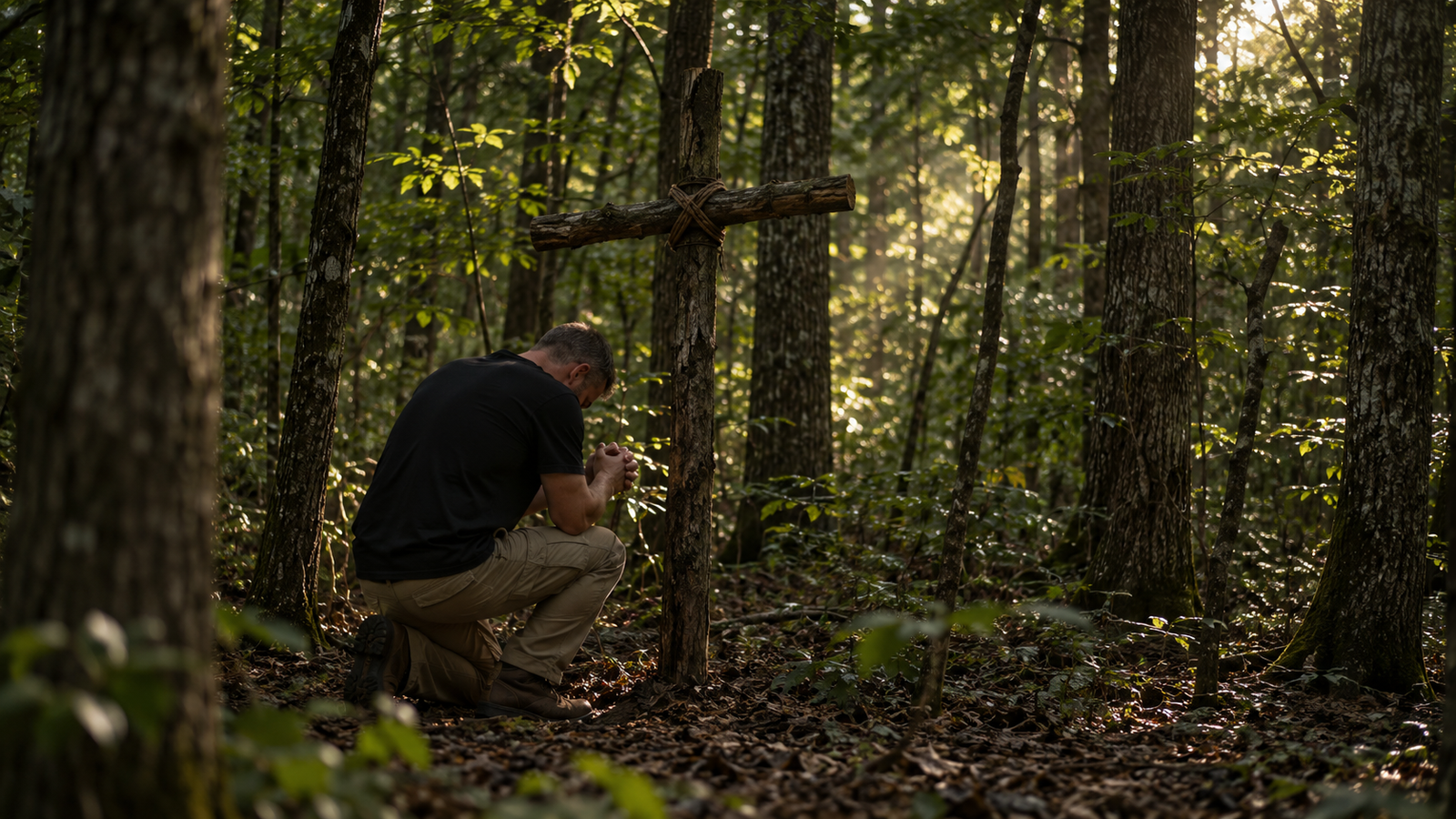
So today I went to my cross in the woods. That place has become somewhere I go when life gets too loud and I need to get alone with God. I went there carrying plenty of my own burdens, but today I also carried theirs. I prayed for this young man. I prayed for his parents and his family. I prayed for healing, strength, wisdom for the doctors, peace in the uncertainty, and God’s unmistakable presence in the days ahead.
And I wept for my friend. Scripture tells us, “Rejoice with those who rejoice, weep with those who weep” (Romans 12:15). Sometimes there isn’t a profound theological statement that needs to be made. Sometimes there isn’t an explanation that makes suffering understandable. Sometimes loving someone simply means hurting because they hurt, praying because you don’t know what else to do, and sitting before God with tears when words aren’t enough.
One of the hardest questions in Christianity is also one of the oldest: Why does God allow things like this to happen? I don’t have a satisfying answer to that question. I know we live in a fallen world. I know suffering, injury, sickness, and death were never part of God’s original perfect creation. I know God is sovereign, and I know Scripture promises that He can work even terrible circumstances for His purposes. But knowing those truths doesn’t make standing beside a hospital bed easy. It doesn’t eliminate fear. It doesn’t make a father’s heart hurt any less. Faith doesn’t require us to pretend something isn’t devastating.
What struck me, though, was something my friend told me. Even in the middle of everything happening around him, he could already see things for which he was thankful. Without sharing the private details of their situation, there have been circumstances surrounding this accident that could have been much worse. He recognizes that. More importantly, he knows God is still in control. That challenged me.
It would be understandable for someone enduring this much in such a short period of time to ask, God, where are You? Yet my friend is looking through the wreckage and recognizing evidence of God’s mercy. He isn’t pretending everything is okay. It isn’t. His family has an incredibly difficult road ahead. But grief and gratitude can occupy the same heart.
That is something I’ve had to learn in my own adversity as well. Being thankful doesn’t mean calling something good that is clearly painful. It means recognizing that God is still good while we’re walking through it.
Paul wrote, “give thanks in all circumstances; for this is the will of God in Christ Jesus for you” (1 Thessalonians 5:18). Notice that Scripture doesn’t tell us to give thanks for every circumstance as though tragedy itself were something to celebrate. It tells us to give thanks in every circumstance. Even here, God remains God. There are still mercies to recognize. There are still prayers being answered. There are still people showing up. There is still hope.
Meanwhile, Back at Work
The other half of my original article dealt with a much smaller kind of adversity, but one that was nevertheless affecting my everyday life: the conflict I was experiencing with a coworker. For a brief moment, I thought that story might have reached a happy ending. We shook hands. We were friendly again. Things seemed normal for about a day.
Then the third-grade antics started again. The tattling to management resumed, and it became apparent that simply shaking hands wasn’t going to fundamentally change the situation. I could continue allowing myself to be frustrated by something I couldn’t control, or I could make a decision about something I could control.
An opportunity came up to move to night shift, and I took it. It isn’t necessarily the solution I would have imagined when all of this started, but it gives me something I desperately need during this season of my life: peace. I’ll have considerably less interaction with this person, and instead of spending my energy worrying about what someone else is saying, doing, watching, or reporting, I can focus on doing my job well and going home.
There’s a lesson in that too. I’ve been using Romans 12:18 a lot lately in my writing, but it continues to be very relevant to what I’m walking through: “If possible, so far as it depends on you, live peaceably with all.” I’ve returned to this verse so often because it is incredibly practical. Paul doesn’t say every relationship will become peaceful. He says, “so far as it depends on you.” Sometimes you pray for someone. Sometimes you forgive someone. Sometimes you shake their hand and try again. And sometimes, when you’ve done what you reasonably can, wisdom means putting some distance between yourself and unnecessary conflict.
Not every battle needs to be fought. I’ve got enough battles right now. There are seasons when protecting a little peace isn’t running away from adversity; it’s recognizing that our emotional and spiritual energy is limited and deciding where it actually belongs. Right now, I’d rather spend that energy praying for a friend’s injured son, praying for my own family, seeking God, doing my work faithfully, and trying to become the man Christ wants me to be than continually getting pulled into petty workplace drama.
When Adversity Doesn’t End on Schedule
When I wrote the first Walking Through Grief and Adversity, I ended with a question I had learned from Charles Stanley: instead of constantly asking, “Why is this happening to me?” ask, “Lord, how should I respond?” A month later, I think that question matters even more.
How should I respond when my friend receives another devastating blow? I can pray. I can weep with him. I can encourage him. I can remind him that he doesn’t have to walk through this alone.
How should I respond when someone at work continues behaving in a way that frustrates me? I can refuse to retaliate. I can continue treating him with dignity. I can do my job faithfully, and when an opportunity presents itself to create some healthy distance and peace, I can take it.
Different adversity requires different responses. Some situations call us to stand our ground. Some call us to change our circumstances. Some call us to sit beside someone who’s hurting. And some bring us to a cross in the woods where all we can do is kneel before God and cry. Today was one of those days.
I stood there thinking about a father and his 20-year-old son whose lives suddenly look very different than they did before that motorcycle accident. I thought about my own boys and how desperately I would want people praying if one of them were lying in a hospital bed. I thought about how fragile our plans really are and how quickly an ordinary day can become a day that divides life into before and after.
And once again I was reminded that control is largely an illusion. We don’t know what phone call may come tomorrow. We don’t know when adversity will arrive or how long it will stay. We don’t get to choose every road God allows us to walk. But we do get to choose where we turn when the road becomes unbearable.
Psalm 46:1 says, “God is our refuge and strength, a very present help in trouble.” Not merely after the trouble. Not once everything has been resolved. Not when we finally understand why it happened. In trouble. Right there in the hospital room. Right there beside the grieving family. Right there on the factory floor. Right there at a wooden cross in the middle of the woods with tears running down your face. God is there.
I don’t know what the coming months will look like for my friend’s son or his family, and it isn’t my story to tell, but I know I will be praying for them. I will be praying that God gives this young man strength for the road ahead and gives his parents everything they need to walk beside him. I will pray that somewhere within an incredibly difficult new normal, they continue seeing those small and large evidences that God has not abandoned them.
And perhaps that’s one of the lessons of adversity that I’m still learning myself. We don’t have to understand everything God allows before we trust Him. Sometimes we simply stand at the cross, weep for the people we love, thank God for the mercies we can still see, and trust Him with everything we cannot.